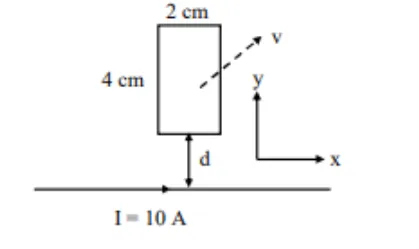
A rectangular conducting loop of length 4 cm and width 2 cm is in the xy-plane, as shown in the figure. It is being moved away from a thin and long conducting wire along the direction with a constant speed v. The wire is carrying a steady current I = 10 A in the positive x-direction. A current of 10 µA flows through the loop when it is at a distance d = 4 cm from the wire. If the resistance of the loop is 0.1 Ω, then the value of v is .
[Given: The permeability of free space ]
Correct Answer :
Solution :
The correct answer is 4 m/s (or 4).
Step 1: Understand the given setup from the problem and diagram
From the given text and image, we have a rectangular loop moving in the xy-plane near a long straight conducting wire carrying a current along the positive x-direction.
• Length of the loop along the y-axis,
• Width of the loop along the x-axis,
• Distance of the bottom edge of the loop from the wire,
• Resistance of the loop,
• Induced current in the loop,
• Velocity of the loop,
Step 2: Determine the induced electromotive force (emf)
The induced emf in the loop is related to the induced current and resistance by Ohm's Law:
Step 3: Calculate the motional emf across each side of the loop
The magnetic field due to an infinitely long current-carrying wire at a distance from the wire is directed perpendicular to the xy-plane (into the page, along ):
The motional emf induced in a segment of length moving with velocity is given by .
Since , we have:
• For the two vertical sides (parallel to the y-axis), motion along the x-direction () produces no net emf because the magnetic field does not vary with x, so the contributions from both vertical sides cancel out completely.
• For the horizontal sides (parallel to the x-axis), the integration along picks up the component .
Therefore, only the vertical component of velocity contributes to the net induced emf across the bottom and top edges of the loop:
Step 4: Express magnetic fields at the bottom and top edges
• Distance of bottom edge from wire,
• Distance of top edge from wire,
Substitute the given numerical values:
Step 5: Solve for the velocity v
Substitute all calculated values into the emf equation:
Thus, the value of is 4.
Access expert-curated educational resources and study materials—completely free.
Create, conduct, and manage professional online assessments with Mindyard. Perfect for teachers and institutes.
Copyright © 2026 Mindyard. All Rights Reserved.