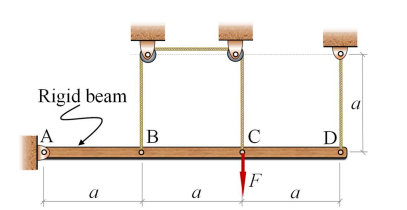
A rigid beam AD of length 3𝑎 = 6 m is hinged at frictionless pin joint A and supported by two strings as shown in the figure. String BC passes over two small frictionless pulleys of negligible radius. All the strings are made of the same material and have equal cross-sectional area. A force 𝐹 = 9 kN is applied at C and the resulting stresses in the strings are within linear elastic limit. The self-weight of the beam is negligible with respect to the applied load. Assuming small deflections, the tension developed in the string at C is _________ kN (round off to 2 decimal places).
Correct Answer :
Correct answer is : 1.5
Solution :
The correct answer is 1.5.
Step 1: Understand the system layout and equilibrium
The rigid beam AD of length 3a = 6 m is hinged at frictionless pin joint A. The beam is supported by:
- A continuous string BC of total length 3a (comprising a vertical segment of length a at B, a horizontal segment of length a, and a vertical segment of length a at C). Since this string is continuous and passes over frictionless pulleys, the tension throughout it is constant and equal to T2.
- A separate string at D of length a under tension T1.
An external vertical downward force F = 9 kN is applied at point C.
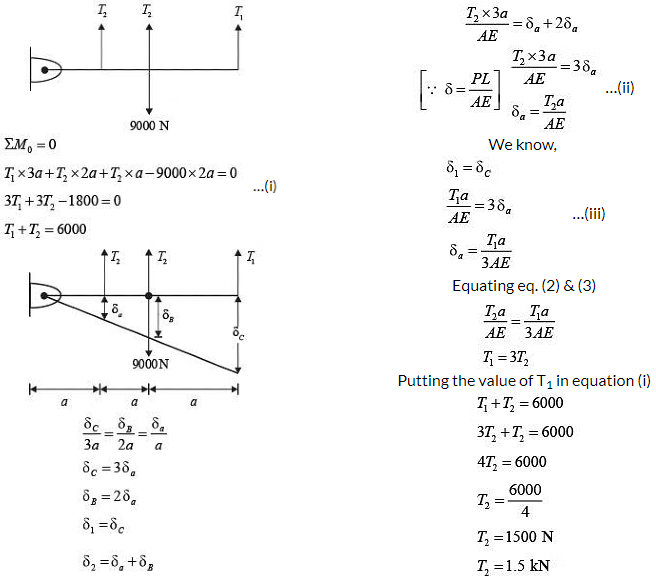
Step 2: Moment equilibrium about hinge A
Taking the sum of moments about the hinge A:
Dividing by a throughout:
Substituting F = 9 kN = 9000 N:
Let this be Equation (1).
Step 3: Deflection compatibility of the rigid beam
Let the downward deflections of the beam at B, C, and D be δB, δC, and δD respectively.
Since the beam AD is rigid and rotates about the hinge A, by similar triangles, the deflections are proportional to their distances from A:
- Distance to B = a, so let δB = δ0
- Distance to C = 2a, so δC = 2δ0
- Distance to D = 3a, so δD = 3δ0
Step 4: Relate deflections to string elongations
The elongation of the string at D (δ1) is equal to the deflection at D:
Using the axial deformation formula δ = PL / (AE) for the string at D (tension T1, length a):
Let this be Equation (2).
The total elongation of the continuous string BC (δ2) is the sum of the downward movements at its attachment points B and C:
For the continuous string BC (tension T2, total length 3a):
Therefore, we have:
Let this be Equation (3).
Step 5: Solve for the tensions
Equating Equation (2) and Equation (3):
Substitute this into Equation (1):
Since the string BC is continuous, the tension developed in the string at C is T2 = 1.5 kN.
Access expert-curated educational resources and study materials—completely free.
Create, conduct, and manage professional online assessments with Mindyard. Perfect for teachers and institutes.
Copyright © 2026 Mindyard. All Rights Reserved.