
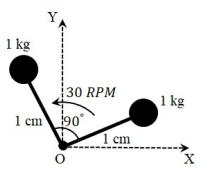
A rigid body in the X-Y plane consists of two point masses (1 kg each) attached to the ends of two massless rods, each of 1 cm length, as shown in the figure. It rotates at 30 RPM counter-clockwise about the Z-axis passing through point O. A point mass of √2 kg, attached to one end of a third massless rod, is used for balancing the body by attaching the free end of the rod to point O. The length of the third rod is ________ cm.
Solution :
The correct answer is 1 (corresponding to the option with title 1).
1. Understanding the System and Visual Data:
Based on the provided figures, we have a rigid body rotating in the X-Y plane about the Z-axis passing through point O with an angular speed corresponding to 30 RPM.
The system consists of the following components:
2. Analysis of Dynamic Balancing:
When the body rotates with angular velocity , each mass experiences a centrifugal force directed radially outwards from the center of rotation O. The centrifugal force vector for any mass at a position vector is given by:
For the system to be dynamically balanced, the net centrifugal force acting on the axis of rotation must be zero. Therefore, the centrifugal force of the balancing mass must exactly cancel out the resultant centrifugal force of the two original masses:
Since is common to all parts of the rotating rigid body, we can divide by to express this condition in terms of the mass-radius vectors:
Taking the magnitude on both sides, we get:
3. Calculating the Resultant Vector Magnitude:
Since the two rods supporting masses 1 and 2 are perpendicular to each other (at 90°), the vectors and are orthogonal. Therefore, we can find the magnitude using the Pythagorean theorem:
4. Step-by-Step Substitution:
Substituting the given values:
Thus, the length of the third rod must be 1 cm to completely balance the system.
Completely free for students. Educators & coaching institutes get 2 months free Pro trial to create tests.
Access unlimited practice questions, detailed step-by-step solutions, and exam study materials — completely free for students.
Create and conduct professional online assessments with AI question generation, tab proctoring, and comprehensive batch management.

A comprehensive JEE Advanced 2022 Paper 1 designed to help aspirants understand the examination pattern, difficulty level, and question trends of JEE Advanced. This paper covers important concepts from Physics, Chemistry, and Mathematics, featuring a balanced mix of conceptual, numerical, and advanced application-based questions. It helps students strengthen conceptual understanding, enhance analytical and problem-solving skills, and improve speed and accuracy. Ideal for practice, revision, self-assessment, previous year trend analysis, concept reinforcement, and time management, this paper is a valuable resource for effective JEE Advanced preparation.

A comprehensive JEE Advanced 2022 Paper 2 designed to help aspirants understand the examination pattern, difficulty level, and question trends of JEE Advanced. This paper covers important concepts from Physics, Chemistry, and Mathematics, featuring a balanced mix of conceptual, numerical, and advanced application-based questions. It helps students strengthen conceptual understanding, enhance analytical and problem-solving skills, and improve speed and accuracy. Ideal for practice, revision, self-assessment, previous year trend analysis, concept reinforcement, and time management, this paper is a valuable resource for effective JEE Advanced preparation.
Copyright © 2026 Combe Labs Private Limited. All Rights Reserved.


