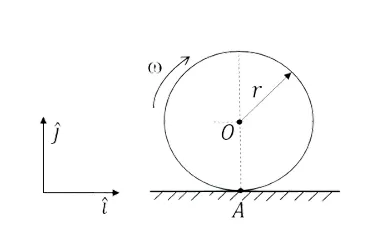
A rigid circular disc of radius r (in m) is rolling without slipping on a flat surface as shown in the figure below. The angular velocity of the disc is ω (in rad/s-1). The velocities (in m/s-1) at points 0 and A, respectively, are:
Correct Answer :
Solution :
The correct answer is:
Step-by-Step Explanation:
1. Analyzing the System from the Image:
Based on the provided illustration, we observe the following details:
- A rigid circular disc of radius is rolling on a flat horizontal surface.
- The center of the disc is denoted by point , and the point of contact with the horizontal flat ground is denoted by point .
- A Cartesian coordinate system is shown on the left, where the horizontal unit vector is (directed to the right) and the vertical unit vector is (directed upwards).
- The circular arrow labeled with angular velocity indicates that the disc is rotating in the clockwise direction.
2. Condition for Pure Rolling (Rolling Without Slipping):
For a body rolling without slipping on a stationary flat surface, the point of contact with the ground must be instantaneously at rest relative to the ground.
Therefore, the velocity of the point of contact is zero:
3. Determining the Velocity at the Center (Point O):
The velocity of any point on a rolling body can be related to the velocity of its center of mass using the relation:
Let us write each term in vector form:
- Let the translation velocity of the center be .
- Since the disc rotates clockwise in the 2D plane, its angular velocity vector points into the page:
- The position vector of the contact point relative to the center is downwards:
Now, substitute these vector terms into the velocity equation:
Using the cross product relation , we simplify:
Since the disc is rolling without slipping:
Thus, the velocity of the center is:
Therefore, the velocities at points and are and respectively.
Access expert-curated educational resources and study materials—completely free.
Create, conduct, and manage professional online assessments with Mindyard. Perfect for teachers and institutes.
Copyright © 2026 Mindyard. All Rights Reserved.