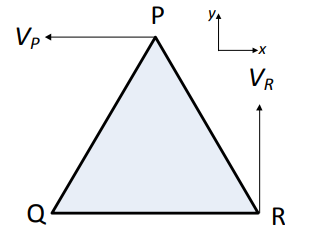
A rigid triangular body, PQR, with sides of equal length of 1 unit moves on a flat plane. At the instant shown, edge QR is parallel to the x-axis, and the body moves such that velocities of points P and R are VP and VR, in the x and y directions, respectively. The magnitude of the angular velocity of the body is
Correct Answer :
2VR
Solution :
The correct option is 2VR.
To find the angular velocity of the rigid triangular body, we can analyze the kinematic relationship between the velocities of two points on a rigid body. For any two points and on a rigid body undergoing planar motion, their velocities are related by the equation:
where:
- is the velocity of point , given as .
- is the velocity of point , given as .
- is the angular velocity of the body.
- is the position vector of relative to .
Let us establish a Cartesian coordinate system with the origin at point . Since the edge is parallel to the x-axis and has a length of 1 unit, the coordinates of and are:
Since is an equilateral triangle with side lengths of 1 unit, the coordinates of point are:
Now, we find the relative position vector of with respect to :
Substitute the velocity vectors and relative position vector into the rigid body velocity formula:
Computing the cross product terms using and gives:
To solve for , we equate the corresponding components on both sides of the equation.
Equating the (y-axis) components:
Rearranging the equation to solve for the magnitude of the angular velocity yields:
Access expert-curated educational resources and study materials—completely free.
Create, conduct, and manage professional online assessments with Mindyard. Perfect for teachers and institutes.
Copyright © 2026 Mindyard. All Rights Reserved.