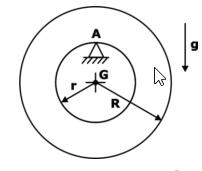
A rigid uniform annular disc is pivoted on a knife edge A in a uniform gravitational field as shown, such that it can execute small amplitude simple harmonic motion in the plane of the figure without slip at the pivot point. The inner radius 𝑟 and outer radius 𝑅 are such that 𝑟2 = 𝑅2/2, and the acceleration due to gravity is 𝑔. If the time period of small amplitude simple harmonic motion is given by T= ßπ√(R/g), where 𝜋 is the ratio of circumference to diameter of a circle, then 𝛽= ________ (round off to 2 decimal places).
Correct Answer :
Correct answer is : 2.66
Solution :
The correct answer is 2.66.
Step-by-step Explanation:
We are given a rigid uniform annular disc with inner radius r and outer radius R such that:
As shown in the diagram, the disc is pivoted on a knife edge A located at the top of the inner boundary (at a distance of r from the center of mass G). The disc executes small amplitude oscillations in its own plane.
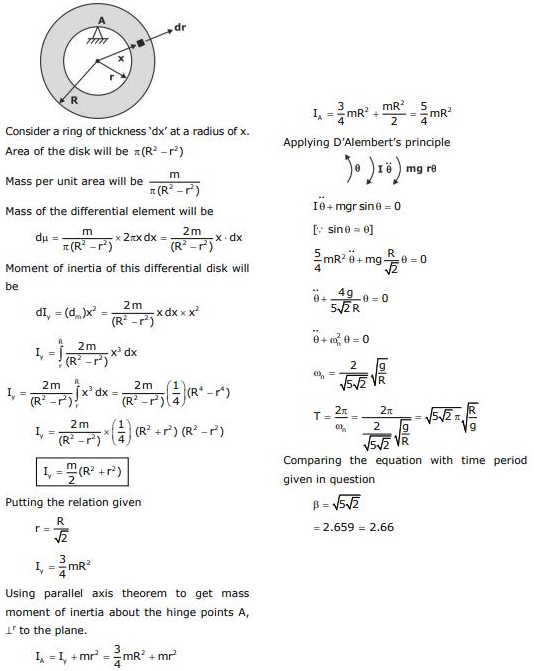
1. Moment of Inertia of the Annular Disc:
The mass moment of inertia of a uniform annular disc of mass m about the axis passing through its center of mass (G) and perpendicular to its plane is given by:
Substituting the given relation into the equation:
2. Moment of Inertia about the Pivot Point A:
Using the parallel axis theorem, we can determine the mass moment of inertia about the pivot point A (which is at a distance of r from G, perpendicular to the plane of the disc):
Substituting the expressions for and :
3. Equation of Motion for Small Amplitude Oscillations:
When the disc is angularly displaced by a small angle about the pivot A, the restoring torque due to the weight of the disc acting at the center of mass G is:
Applying the small-angle approximation where , the restoring torque becomes:
Applying the equation of rotational motion :
Substituting the values of and :
Simplifying the differential equation by dividing by :
4. Time Period of Simple Harmonic Motion:
Comparing this with the standard equation for simple harmonic motion , we find the angular frequency :
The time period T of the oscillation is given by:
Comparing this with the given format :
Evaluating this numerically using :
Rounding off to two decimal places, we get:
β = 2.66
Access expert-curated educational resources and study materials—completely free.
Create, conduct, and manage professional online assessments with Mindyard. Perfect for teachers and institutes.
Copyright © 2026 Mindyard. All Rights Reserved.