A road is divided into four sections having varying widths as shown in the figure. Section-2 (S2) represents a capacity constrained condition with respect to the traffic flow passing through Section-1 (S1). Section-3 (S3) and Section-4 (S4) do not face any such capacity constraint with respect to the flow. A flow-density re lationship for unconstrained and constrained flow conditions is shown in the figure.
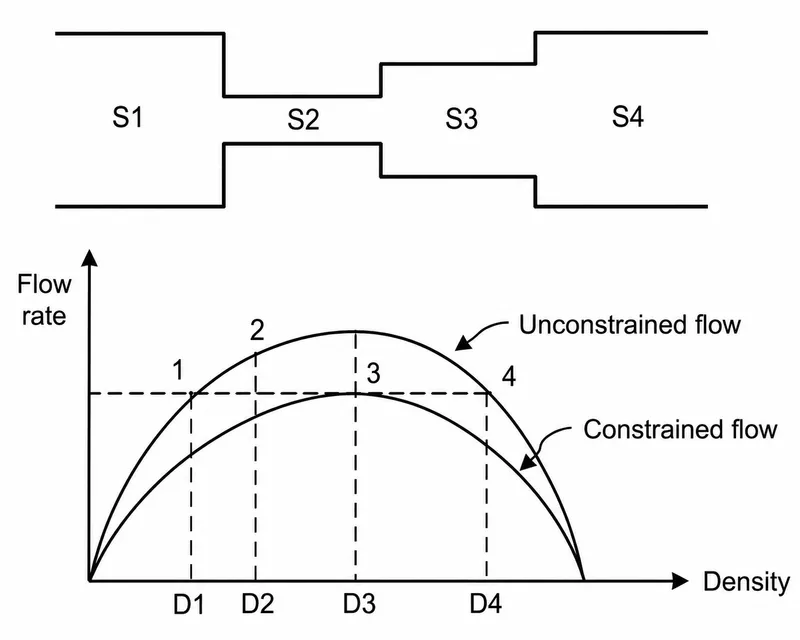
If Section-1 observes density D2, the option representing the correct state of den sity in Sections 2, 3 and 4 is:
Correct Answer :
S2- D4 ; S3- D3 ; S4- D1
Solution :
The correct option/answer is: S2- D4 ; S3- D3 ; S4- D1
Detailed Step-by-Step Explanation:
1. Analysis of the Road Sections and Graph:
From the given schematic, the road is divided into four sections with varying widths:
• Section-1 (S1) is the wide approach section operating under unconstrained flow conditions.
• Section-2 (S2) is a narrow bottleneck representing a capacity-constrained section.
• Section-3 (S3) has a width between S2 and S1, operating under unconstrained conditions.
• Section-4 (S4) is wider, returning to the width of S1, also operating under unconstrained conditions.
Looking at the flow-density graph:
• There are two curves: the upper curve representing Unconstrained flow and the lower curve representing Constrained flow.
• S1, S3, and S4 operate on the unconstrained curve, while S2 operates on the constrained curve.
• Density
D1 corresponds to a low-density, free-flow state on the unconstrained curve.
• Density
D2 corresponds to the incoming flow state on the unconstrained curve, which has a higher flow rate
q2.
• Density
D3 corresponds to the peak capacity (maximum flow rate
q3) of the constrained flow curve (representing S2).
• Density
D4 corresponds to a high-density, congested state on the unconstrained curve.
2. Traffic State Transitions:
• For Section-1 (S1): The input state is given as density
D2. The corresponding flow rate
q2 is higher than the capacity
q3 of the constrained section S2.
• For Section-2 (S2): Since the incoming flow demand
q2 exceeds the capacity of Section-2 (which is
q3), Section-2 acts as a bottleneck. This capacity constraint forces the traffic in Section-2 to operate under congested, forced flow conditions. Because the bottleneck restricts the flow to its maximum limit and creates a queue, Section-2 experiences a highly congested state. In the given system, this congested state corresponds to the maximum density point
D4.
• For Section-3 (S3): Downstream of the bottleneck, the traffic begins to transition back. S3 is wider and unconstrained. The flow passing through S3 is the restricted flow
q3 coming from the bottleneck. At this flow rate
q3, the intermediate section S3 experiences density
D3.
• For Section-4 (S4): In the final, widest section, the flow remains
q3 but the road width has fully opened up. Under unconstrained free-flow conditions, the traffic recovers completely, resulting in a low density state corresponding to
D1.
Thus, the correct states of density in Sections 2, 3, and 4 are:
• Section-2 (S2): D4
• Section-3 (S3): D3
• Section-4 (S4): D1
Access expert-curated educational resources and study materials—completely free.
Create, conduct, and manage professional online assessments with Mindyard. Perfect for teachers and institutes.
Copyright © 2026 Mindyard. All Rights Reserved.