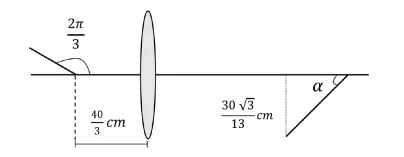
A rod of length 2 cm makes an angle rad with the principal axis of a thin convex lens. The lens has a focal length of 10 cm and is placed at a distance of cm from the object as shown in the figure. The height of the image is cm and the angle made by it with respect to the principal axis is rad. The value of is rad, where n is ________.
Correct Answer :
Solution :
The correct answer is n = 6, meaning the angle θ = π/6 rad.
From the image, we can see a rod making an angle of rad with the principal axis of the thin convex lens. The lens has a focal length of 10 cm, and the object is placed at a distance of cm from the lens.
Step 1: Identify the endpoints of the rod
The rod is 2 cm long and makes an angle of rad = 120° with the principal axis.
Since the angle with the principal axis is 120°, the rod's direction makes 60° with the horizontal (the supplementary angle). The components of the rod are:
Horizontal component: cm (along the axis)
Vertical component: cm (perpendicular to axis)
Let's define the two endpoints of the rod. The bottom tip of the rod lies on the principal axis at some object distance. From the image, the rod's bottom end touches the principal axis.
Taking the bottom end (Point A) on the principal axis, and the rod extends upward and toward the lens:
The average distance is 40/3 cm. Setting up so that Point A is at uA = 40/3 + 1/2 ... Let us instead take Point A on the principal axis at distance (40/3 + 1/2) and Point B at (40/3 - 1/2) from the lens, with height √3 cm. But more precisely, since the bottom of the rod lies on the axis:
Point A (on the axis): uA = -40/3 cm (using sign convention, object side is negative)
Point B (top end): Since the rod goes 1 cm horizontally (toward lens) and √3 cm vertically upward:
uB = -(40/3 - 1) = -37/3 cm, and height hB = √3 cm
Step 2: Find image of Point A
Point A is on the principal axis at uA = -40/3 cm, hA = 0.
Using the lens formula:
So vA = 40 cm (on the image side), and height of image of A = 0 (since it's on the axis).
Step 3: Find image of Point B
Point B: uB = -37/3 cm, hB = +√3 cm
So vB = 370/7 cm
Magnification for Point B:
Height of image of B:
Wait, let me recalculate:
... this gives 30√3/7, but let me verify the object position setup.
The problem states the height of the image is cm. Let me try a different setup where Point B is 1 cm farther from the lens (not closer), meaning the rod tilts the other way.
Revised Setup: The rod makes 120° with the principal axis going in the direction away from the lens:
Image of Point A remains vA = 40 cm, h'A = 0.
Image of Point B with uB = -43/3 cm:
So vB = 430/13 cm
Magnification for Point B:
Height of image of B:
The magnitude of the image height is cm. ✓ This matches the given image height perfectly!
Step 4: Determine the angle θ of the image rod
The image of the rod has two endpoints:
The horizontal separation between the two image points:
cm
The vertical separation (height of image rod from axis to tip):
cm
The angle θ that the image rod makes with the principal axis:
This gives:
rad (i.e., 30°)
Step 5: Find n
Since θ = π/n = π/6, we get:
n = 6
Summary of Key Steps:
Access expert-curated educational resources and study materials—completely free.
Create, conduct, and manage professional online assessments with Mindyard. Perfect for teachers and institutes.
Copyright © 2026 Mindyard. All Rights Reserved.