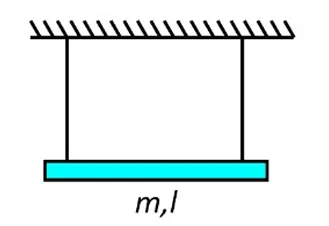
A rod of mass m and length l is attached to two ideal strings. Find tension in left string just after right string is cut.
Correct Answer :
mg/4
Solution :
The correct answer is mg/4.
From the provided image, we see a uniform horizontal rod of mass and length (labeled "" directly beneath the blue rod) suspended symmetrically by two vertical strings attached at its ends.
Immediately after the right string is cut, its tension drop to zero. The rod begins to accelerate downwards and rotate about its center of mass. Let:
- be the tension in the remaining left string,
- be the downward acceleration of the center of mass of the rod, and
- be the angular acceleration of the rod about its center of mass.
We write Newton's second law for the translational motion of the center of mass in the vertical direction:
(Equation 1)
Next, we write the torque equation about the center of mass. The tension at the left end acts at a distance of from the center of mass, producing torque:
The moment of inertia of a uniform rod about its center of mass is:
Applying the torque relation :
(Equation 2)
Simplifying Equation 2 for the angular acceleration yields:
(Equation 3)
Since the left string is inextensible and remains taut, the instantaneous vertical acceleration of the left end of the rod must be zero. The acceleration of the left end is the combination of the downward translation of the center of mass and the upward rotational acceleration at that end:
This gives the kinematic constraint relation:
(Equation 4)
Substituting the value of from Equation 3 into Equation 4 gives:
(Equation 5)
Finally, we substitute the expression for from Equation 5 into Equation 1:
Thus, the tension in the left string immediately after the right string is cut is indeed .
Access expert-curated educational resources and study materials—completely free.
Create, conduct, and manage professional online assessments with Mindyard. Perfect for teachers and institutes.
Copyright © 2026 Mindyard. All Rights Reserved.