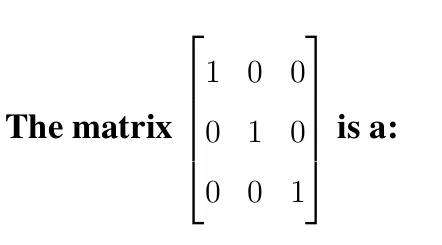
(A) Scalar matrix
(B) Diagonal matrix
(C) Skew-symmetric matrix
(D) Symmetric matrix
Choose the correct answer from the options given below:
Correct Answer :
(A), (B), and (D) only
Solution :
The correct answer is: (A), (B), and (D) only.
Based on the provided image, the matrix to classify is the identity matrix of order 3, denoted as:
We analyze each of the given classifications step-by-step:
1. Diagonal matrix (B):
A square matrix is classified as a diagonal matrix if all its non-diagonal elements are zero. Formally, for a matrix , it is a diagonal matrix if for all .
For the given matrix, all off-diagonal elements are indeed . Therefore, it is a diagonal matrix. Statement (B) is correct.
2. Scalar matrix (A):
A diagonal matrix is classified as a scalar matrix if all of its main diagonal elements are equal to a single scalar value. Formally, for all , where is a constant.
For the given matrix, the diagonal elements are:
Since all main diagonal elements are equal to , it is a scalar matrix. Statement (A) is correct.
3. Symmetric matrix (D):
A square matrix is symmetric if it is equal to its transpose, meaning . Taking the transpose of by swapping its rows and columns gives:
Since , the matrix is a symmetric matrix. Statement (D) is correct.
4. Skew-symmetric matrix (C):
A square matrix is skew-symmetric if . This definition requires the main diagonal elements to satisfy , which is only possible if all diagonal elements are .
Since the main diagonal elements of the given matrix are all , and:
The matrix is not a skew-symmetric matrix. Statement (C) is incorrect.
Comparing our findings, statements (A), (B), and (D) are correct, which corresponds to the option (A), (B), and (D) only.
Access expert-curated educational resources and study materials—completely free.
Create, conduct, and manage professional online assessments with Mindyard. Perfect for teachers and institutes.
Copyright © 2026 Mindyard. All Rights Reserved.