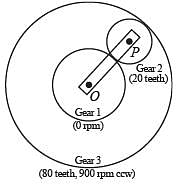
A schematic of an epicyclic gear train is shown in the figure. The sun (gear 1) and planet (gear 2) are external, and the ring gear (gear 3) is internal. Gear 1, gear 3 and arm OP are pivoted to the ground at O. Gear 2 is carried on the arm OP via the pivot joint at P, and is in mesh with the other two gears. Gear 2 has 20 teeth and gear 3 has 80 teeth. If gear 1 is kept fixed at 0 rpm and gear 3 rotates at 900 rpm counter clockwise (ccw), the magnitude of angular velocity of arm OP is ________ rpm (in integer).
Correct Answer :
Correct answer is : 600
T1 = ?, T2 = 20, T3 = 80
N3 = 900 rpm (ccw), N1 = 0 rpm (fixed)
Since the module of all mating gears is always the same, hence radius can be expressed as:
r3 = r1 + 2r2
⇒ T3 = T1 + 2T2
T1 = 80 - 40 = 40 teeth
According to the tabular method:
| Motions | Arm | Gear 1 (40) |
Gear 2 (20) |
Gear 3 (80) |
| Arm fixed, gear1 rotate +x revolutions |
0 | + x | ||
| Arm effect is considered |
y | y + x | y - 2x | y - (x/2) |
It is given that:
N1 = 0 ⇒ y + x = 0
N3 = 900 rpm ⇒ y - (x/2) = 900
on solving we get,
3y/2 = 900 ⇒ y = 600 rpm
x = - 600 rpm
Speed of arm OP = y (from table)
Speed of arm is 600 rpm counter - clockwise.
Solution :
The correct answer is 600.
Analysis of the Gear Train from the Figure:
By inspecting the provided schematic diagram, we observe:
Step 1: Determine the Number of Teeth on Gear 1
From the geometry of the epicyclic gear train shown in the figure, the outer radius of the ring gear must equal the radius of the sun gear plus the diameter of the planet gear:
Since the module () is identical for all mating gears, the radii are directly proportional to the number of teeth (). Substituting this relationship gives:
Given that and :
Step 2: Set up the Tabular Method for Motion Analysis
We analyze the rotations of each member using the tabular method. Let counter-clockwise (ccw) rotation be positive (+).
| Operation / Condition | Arm OP | Gear 1 (T1 = 40) | Gear 2 (T2 = 20) | Gear 3 (T3 = 80) |
|---|---|---|---|---|
| 1. Arm fixed, Gear 1 rotates by +x | 0 | +x | ||
| 2. Add rotation +y of the arm | y | y + x | y - 2x | y - x/2 |
Step 3: Solve for the Speeds using Boundary Conditions
We are given:
1. Gear 1 is fixed:
2. Gear 3 rotates at 900 rpm ccw (positive direction):
Substitute into the equation for Gear 3:
The speed of the arm OP is represented by in the table. Therefore, the magnitude of the angular velocity of the arm OP is 600 rpm (rotating in a counter-clockwise direction).
Access expert-curated educational resources and study materials—completely free.
Create, conduct, and manage professional online assessments with Mindyard. Perfect for teachers and institutes.
Copyright © 2026 Mindyard. All Rights Reserved.