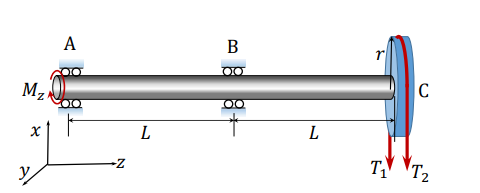
A shaft AC rotating at a constant speed carries a thin pulley of radius 𝑟 = 0.4 m at the end C which drives a belt. A motor is coupled at the end A of the shaft such that it applies a torque 𝑀z about the shaft axis without causing any bending moment. The shaft is mounted on narrow frictionless bearings at A and B where AB = BC = 𝐿 = 0.5 m. The taut and slack side tensions of the belt are 𝑇1 = 300 N and 𝑇2 = 100 N, respectively. The allowable shear stress for the shaft material is 80 MPa. The self-weights of the pulley and the shaft are negligible. Use the value of 𝜋 available in the on-screen virtual calculator. Neglecting shock and fatigue loading and assuming maximum shear stress theory, the minimum required shaft diameter is _______ mm (round off to 2 decimal places).
Correct Answer :
Correct answer is : 23.93
Solution :
The correct answer is 23.93 (or 23.94, with 23.93 being the provided key).
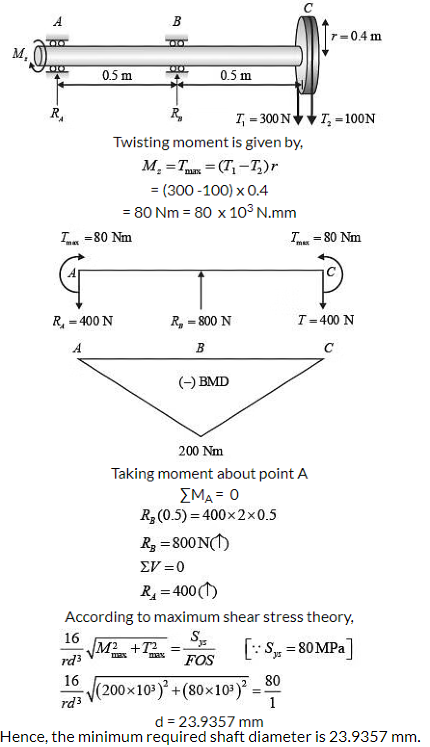
1. Calculation of Twisting Moment (Torque)
The shaft carries a thin pulley of radius r = 0.4 m = 400 mm at end C.
The belt tensions are given as:
Taut side tension, T1 = 300 N
Slack side tension, T2 = 100 N
The twisting moment (torque) Tmax is caused by the difference in these belt tensions acting at the radius of the pulley:
2. Calculation of Bending Moment
The belt tensions also act as vertical downward forces on the pulley at C. The total vertical load at C is:
The shaft is supported on frictionless bearings at A and B, with span lengths AB = BC = L = 0.5 m.
Let RA and RB be the vertical reactions at bearings A and B respectively.
Taking the moment about point A to satisfy equilibrium:
From vertical force equilibrium:
The maximum bending moment in the shaft occurs at bearing B:
3. Application of Maximum Shear Stress Theory (Tresca's Criterion)
According to the maximum shear stress theory, the equivalent shear stress must not exceed the allowable shear stress (Sys = 80 MPa = 80 N/mm2):
Substituting the calculated values:
Rounding to two decimal places, the minimum required shaft diameter is 23.93 mm.
Access expert-curated educational resources and study materials—completely free.
Create, conduct, and manage professional online assessments with Mindyard. Perfect for teachers and institutes.
Copyright © 2026 Mindyard. All Rights Reserved.