A short shoe drum (radius 260 mm) brake is shown in the figure. A force of 1 kN is applied to the lever. The coefficient of friction is 0.4.
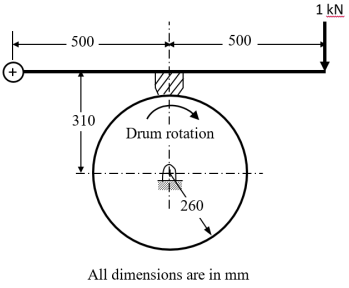
The magnitude of the torque applied by the brake is ____________ N.m (round off to one decimal place).
Correct Answer :
Correct answer is : 200
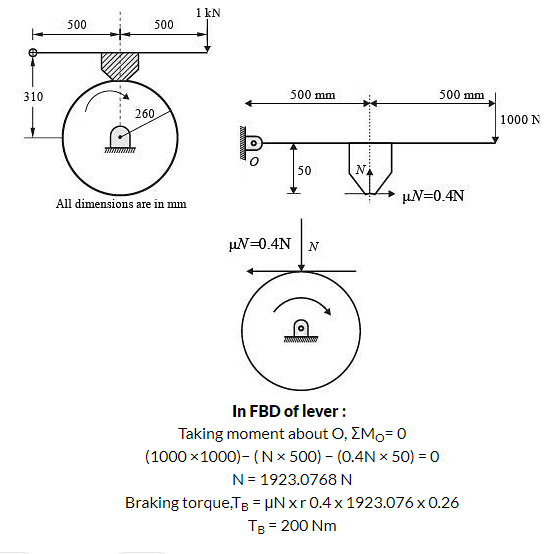
Solution :
The correct answer is 200.
Step-by-Step Explanation:
1. Identify the given values from the question and the schematic diagrams:
- Radius of the brake drum,
- Applied force on the lever,
- Coefficient of friction,
- Horizontal distance from pivot O to the center line of the shoe,
- Horizontal distance from pivot O to the applied force,
- Vertical distance from pivot O to the drum center,
2. Calculate the distance from pivot O to the contact surface:
The vertical distance from pivot O to the contact surface (top of the drum) is:
3. Analyze the forces and their directions:
- The normal force acts vertically upwards on the shoe (from the drum).
- The drum rotates clockwise, which means the surface velocity at the top point of contact is directed to the right. Therefore, the friction force on the drum acts to the left, and by Newton's third law, the friction force on the shoe acts to the right, with a magnitude of .
4. Take the moment about pivot O:
For static equilibrium of the lever, the sum of moments about pivot O must be zero ():
Substituting the values into the moment equation:
5. Calculate the braking torque:
The braking torque () applied by the friction shoe on the drum is given by:
Access expert-curated educational resources and study materials—completely free.
Create, conduct, and manage professional online assessments with Mindyard. Perfect for teachers and institutes.
Copyright © 2026 Mindyard. All Rights Reserved.