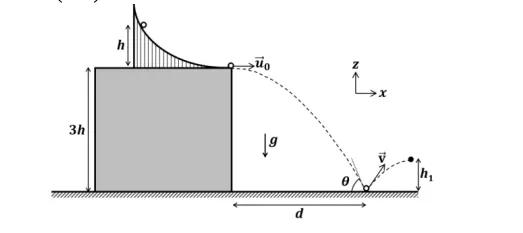
A slide with a frictionless curved surface, which becomes horizontal at its lower end, is fixed on the terrace of a building of height 3h from the ground, as shown in the figure. A spherical ball of mass m is released on the slide from rest at a height h from the top of the terrace. The ball leaves the slide with a velocity and falls on the ground at a distance d from the building making an angle θ with the horizontal. It bounces off with a velocity v and reaches a maximum height h1. The acceleration due to gravity is g and the coefficient of restitution of the ground is . Which of the following statement(s) is(are) correct?
Correct Answer :
u0 =
θ = 60°
Solution :
The correct options are:
u0 = ,
θ = 60°, and
.
Step 1: Determine the horizontal velocity of the ball on leaving the slide
Using conservation of energy for the ball sliding down the frictionless surface of height h:
Solving for :
Since it leaves horizontally in the positive x-direction:
Thus, the first option is correct.
Step 2: Motion of the ball from the terrace to the ground
The height of the building is 3h. The vertical motion under gravity yields the time of flight t:
The horizontal distance d travelled before striking the ground is:
Step 3: Finding the striking velocity and angle θ
Just before hitting the ground, the velocity components are:
Horizontal component:
Vertical component (downwards):
The angle θ made by the trajectory with the horizontal at the moment of impact is:
Therefore:
Thus, the third option is correct.
Step 4: Motion after bouncing from the ground
The coefficient of restitution is .
During the collision with the smooth ground, the horizontal velocity component remains unchanged, while the vertical component reverses direction and its magnitude becomes:
The rebound velocity vector is given by:
(Note: This makes option 2 incorrect because the vertical unit vector after rebound points upwards, not downwards).
Step 5: Calculate maximum height h1 reached after collision
The maximum height reached after the bounce depends solely on the vertical rebound velocity component :
Step 6: Ratio of d to h1
Using our derived values and :
Thus, the fourth option is also correct.
Access expert-curated educational resources and study materials—completely free.
Create, conduct, and manage professional online assessments with Mindyard. Perfect for teachers and institutes.
Copyright © 2026 Mindyard. All Rights Reserved.