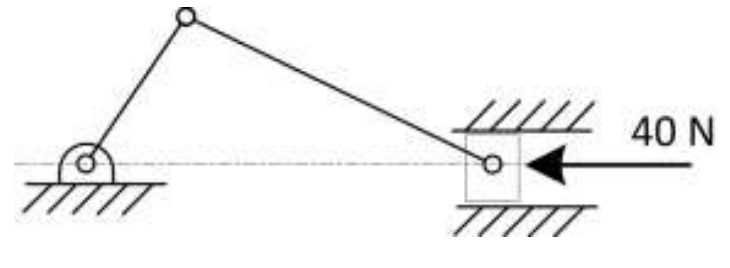
A slider crank mechanism is shown in the figure. At some instant, the crank angle is 45o and a force of 40 N is acting towards the left on the slider. The length of the crank is 30 mm and the connecting rod is 70 mm. Ignoring the effect of gravity, friction and inertial forces, the magnitude of the crankshaft torque (in Nm) needed to keep the mechanism in equilibrium is _________ (correct to two decimal places).
Correct Answer :
Solution :
The correct answer is 1.12.
1. Identify the given parameters from the problem description and the provided diagram:
The diagram shows a slider-crank mechanism where a horizontal force is applied to the slider. The specific parameters are:
- Crank length,
- Connecting rod length,
- Crank angle,
- Horizontal force on the slider (directed towards the left, as indicated by the arrow labelled "40 N" in the diagram),
2. Calculate the connecting rod angle ():
From the geometry of the slider-crank mechanism, using the sine rule:
Substituting the given values:
Now, calculate using the trigonometric identity:
Thus, is:
3. Calculate the crankshaft torque () for equilibrium:
The relationship between the slider force and the equilibrium crankshaft torque is given by the formula:
Using the trigonometric identity for the sine of a sum:
For , we have :
Substitute these values back into the torque equation:
Rounding to two decimal places, the magnitude of the crankshaft torque is 1.12 Nm.
Access expert-curated educational resources and study materials—completely free.
Create, conduct, and manage professional online assessments with Mindyard. Perfect for teachers and institutes.
Copyright © 2026 Mindyard. All Rights Reserved.