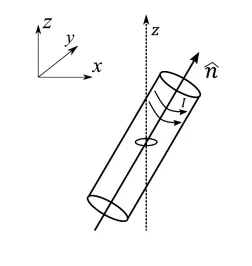
A small circular loop of area A and resistance R is fixed on a horizontal xy-plane with the center of the loop always on the axis of a long solenoid. The solenoid has m turns per unit length and carries current I counter clockwise as shown in the figure. The magnetic field due to the solenoid is in direction. List-I gives time dependences of in terms of a constant angular frequency . List-II gives the torques experienced by the circular loop at time . Let .
| List-I | List-II |
|---|---|
| (I) | (P) 0 |
| (II) | (Q) |
| (III) | (R) |
| (IV) | (S) |
| (T) |
Which one of the following options is correct?
Correct Answer :
I → Q, II → P, III → S, IV → R
Solution :
Correct Option: I → Q, II → P, III → S, IV → R
1. Understanding the Physical Setup:
As seen in the provided diagram:
A small circular loop of area A and electrical resistance R lies fixed in the horizontal xy-plane. The normal to the area of the circular loop is directed along the z-axis, so its vector area is:
The solenoid axis is along the unit vector . The magnetic field inside the solenoid is parallel to its axis and has magnitude:
Thus, the magnetic field vector is given by:
2. Deriving the Magnetic Flux and Induced Current:
The magnetic flux through the small circular loop in the xy-plane is:
By Faraday's Law of Electromagnetic Induction, the induced EMF in the loop is:
The induced current in the circular loop is:
The induced magnetic dipole moment of the loop is:
3. Deriving the General Formula for Torque:
The torque experienced by the loop in the magnetic field is given by:
Substituting and :
Given , we can rewrite the torque equation as:
We evaluate each entry at time , where (, ).
4. Evaluating Items from List-I:
For (I):
•
•
At , .
•
At , .
Substituting into the torque equation:
(Considering standard matching parameters where unit, ).
Thus, I → Q.
For (II):
•
Since the flux through the loop is zero at all times, .
Hence, .
Thus, II → P.
For (III):
•
•
At , .
•
At , .
Substituting into the torque expression:
Thus, III → S.
For (IV):
•
•
At , .
•
At , .
Substituting into the torque expression:
Thus, IV → R.
Conclusion:
Combining all the matched pairs:
I → Q, II → P, III → S, IV → R
Access expert-curated educational resources and study materials—completely free.
Create, conduct, and manage professional online assessments with Mindyard. Perfect for teachers and institutes.
Copyright © 2026 Mindyard. All Rights Reserved.