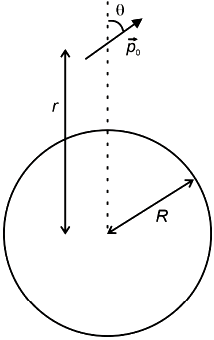
A small electric dipole , having a moment of inertia I about its center, is kept at a distance r from the center of a spherical shell of radius R. The surface charge density σ is uniformly distributed on the spherical shell. The dipole is initially oriented at a small angle 𝜃 as shown in the figure. While staying at a distance r, the dipole is free to rotate about its center.
If released from rest, then which of the following statement(s) is(are) correct ?
[𝜀0 is the permittivity of free space.]
Correct Answer :
The dipole will undergo small oscillations at any finite value of r > R.
The dipole will undergo small oscillations with an angular frequency of at r = 10R
Solution :
Correct Statements:
1. The dipole will undergo small oscillations at any finite value of r > R.
2. The dipole will undergo small oscillations with an angular frequency of
at r = 10R.
Step-by-Step Explanation:
1. Electric Field due to the Spherical Shell:
The spherical shell has radius and uniform surface charge density . The total charge on the shell is given by:
Using Gauss's Law, the electric field at a distance from the center of the shell is:
- For (inside the shell): The electric field is zero ().
- For (outside the shell): The electric field points radially outwards and has the magnitude:
2. Restoring Torque on the Dipole:
As shown in the figure, the dipole is placed at a distance along the radial line from the center, making a small angle with the radial line (which represents the direction of the electric field ).
The torque acting on the dipole is:
The magnitude of the restoring torque is:
For small angular displacement , we approximate :
3. Equation of Motion and Angular Frequency:
The rotational equation of motion about the center of the dipole is:
Rearranging the terms:
This matches the standard equation for simple harmonic motion (). Thus, the dipole undergoes small oscillations for any finite value of where the field is non-zero.
The angular frequency of oscillation is:
4. Calculation at r = 10R:
Substituting into the expression for angular frequency:
Access expert-curated educational resources and study materials—completely free.
Create, conduct, and manage professional online assessments with Mindyard. Perfect for teachers and institutes.
Copyright © 2026 Mindyard. All Rights Reserved.