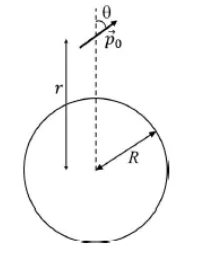
If released from rest, then which of the following statement(s) is(are) correct?
[ε0 is the permittivity of free space.]
Correct Answer :
Solution :
Correct Options:
1. The dipole will undergo small oscillations at any finite value of .
2. The dipole will undergo small oscillations with an angular frequency of at .
Detailed Step-by-Step Explanation:
Step 1: Electric Field due to the Uniformly Charged Spherical Shell
As shown in the figure, a spherical shell of radius has a uniform surface charge density .
The total charge on the shell is given by:
By Gauss's Law, the electric field at a distance from the center of the spherical shell depends on whether the point is inside or outside the shell:
1. Inside the shell (): The electric field is zero (). Hence, no torque acts on the dipole inside the shell, so oscillations do not occur for .
2. Outside the shell (): The electric field is radially outwards (assuming positive charge) and has a magnitude of:
Step 2: Restoring Torque on the Dipole
The electric field vector points along the radial line (dashed line connecting the center of the sphere to the center of the dipole).
The dipole moment vector makes a small angle with respect to the radial axis.
The magnitude of the restoring torque acting on the dipole is given by:
Since is a small angle, we can use the small-angle approximation :
Because the torque acts to decrease and restore the dipole back towards its radial alignment, the dipole will perform simple harmonic oscillations for any finite distance .
Step 3: Calculating Angular Frequency of Oscillations
Using Newton's second law for rotation, :
Comparing this with the standard Simple Harmonic Motion (SHM) equation , the angular frequency is:
Step 4: Evaluating Angular Frequency at Specific Positions
Now, let's substitute into the expression for :
Thus, at , the dipole undergoes small oscillations with an angular frequency of .
Hence, the correct options are:
- The dipole will undergo small oscillations at any finite value of .
- The dipole will undergo small oscillations with an angular frequency of at .
Access expert-curated educational resources and study materials—completely free.
Create, conduct, and manage professional online assessments with Mindyard. Perfect for teachers and institutes.
Copyright © 2026 Mindyard. All Rights Reserved.