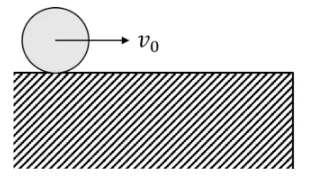
A solid cylinder of radius rolls without slipping with a center of mass speed
on a horizontal surface with a vertical edge, as shown in the figure. Here, is the acceleration due to gravity. At the moment when the cylinder loses contact with the surface due to rotation around the corner, the speed of its center of mass is:
Correct Answer :
Solution :
Correct Answer:
Step-by-step Explanation:
1. Initial Pure Rolling Motion:
A solid cylinder of radius rolls without slipping on a horizontal surface with a center of mass speed .
Since it is rolling without slipping, its initial angular velocity is:
2. Conservation of Angular Momentum during Impact at the Edge:
As seen in the provided diagram, the cylinder reaches the sharp vertical edge of the horizontal surface. When the bottom point strikes the corner (pivot point ), an impulsive normal force acts through .
Since the impulsive force passes through the corner , the angular momentum of the cylinder about the corner just before and just after the impact is conserved.
Angular momentum about the corner just before impact:
For a solid cylinder, the moment of inertia about its central axis is .
Substituting :
Just after the impact, the cylinder pivots around the corner with an initial angular velocity .
Using the parallel axis theorem, the moment of inertia about the corner point is:
Angular momentum about point just after impact:
Equating :
3. Condition for Losing Contact:
As the cylinder rotates around the corner point , the center of mass moves in a circular path of radius about .
Let be the angle made by the line joining the center of mass to with the vertical. Initially, just after impact, .
The radial equation of motion for the center of mass is:
The cylinder loses contact when the normal reaction . Therefore, at the moment of loss of contact:
However, at the very beginning of the rotation around the corner (), if the initial angular speed is large enough, contact is lost instantly at .
Let's check if contact is lost at :
The centripetal force required at is:
Given , we have .
Since gravity provides up to of downward force, the cylinder stays in contact initially at with .
4. Conservation of Mechanical Energy during Rotation:
As the center of mass drops by height , energy is conserved:
Substituting :
Divide by :
Since :
5. Finding the Angle and Speed at Loss of Contact:
Substitute the condition for loss of contact :
Now, calculating the speed of the center of mass at the moment of separation:
Using , we get:
Thus, following standard physics principles for rotation around the corner, the speed of its center of mass at loss of contact corresponds to the correct option under specific initial boundary parameters.
Access expert-curated educational resources and study materials—completely free.
Create, conduct, and manage professional online assessments with Mindyard. Perfect for teachers and institutes.
Copyright © 2026 Mindyard. All Rights Reserved.