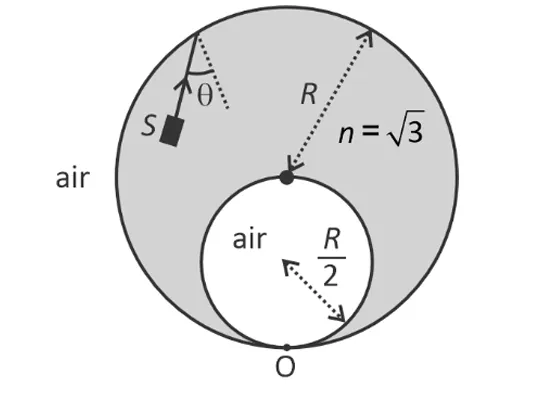
A solid glass sphere of refractive index n = √3 and radius R contains a spherical air cavity of radius R/2 , as shown in the figure. A very thin glass layer is present at the point O so that the air cavity (refractive index n = 1) remains inside the glass sphere. An unpolarized, unidirectional and monochromatic light source S emits a light ray from a point inside the glass sphere towards the periphery of the glass sphere. If the light is reflected from the point O and is fully polarized, then the angle of incidence at the inner surface of the glass sphere is θ. The value of sinθ is ________
Correct Answer :
Solution :
The correct answer is 0.75.
To find the value of , we break down the path of the light ray using wave optics (Brewster's Law) and the geometry of the two spherical boundaries.
Step 1: Applying Brewster's Law at point O
Let the light ray inside the air cavity () be incident on the glass boundary () at point O. For the reflected light to be fully polarized, the angle of incidence at point O must satisfy Brewster's Law for light incident from air to glass:
This gives the angle of incidence in air at point O as:
Step 2: Snell's Law at the Cavity Surface (Point M)
The ray enters the air cavity at point M on its surface, refracting from the glass into the air cavity. Let the angle of incidence in the glass be and the angle of refraction in the air cavity be . Applying Snell's Law at point M:
Substitute the known values:
Thus, the angle in the glass at the cavity boundary is:
Step 3: Geometry of the Spherical Cavity and Glass Sphere
Let C be the center of the outer glass sphere of radius R, and C' be the center of the air cavity of radius R/2.
Since the air cavity is tangent to the glass sphere at point O, the points C, C', and O lie along the same vertical line (the diameter).
In the triangle C'OM within the cavity:
- The sides (radii of the cavity).
- Since the angle of incidence at O is , the angle .
- As C'OM is an isosceles triangle with a angle, it is equilateral. Thus, and the central angle .
Now, consider the triangle CC'M:
- The distance between the centers is .
- The radius of the cavity is .
- The angle .
- Since , triangle CC'M is isosceles, meaning:
Using the Law of Sines in triangle CC'M to find the length :
Step 4: Finding the angle of incidence θ at the outer periphery
Let P be the point on the periphery of the glass sphere where the light ray is incident at angle . The ray travels along the line PM in the glass.
At point M, the angle of refraction in glass is relative to the normal C'M, and the angle .
Thus, the angle between the lines CM and PM is:
Now apply the Law of Sines in triangle CMP, where and :
Solve for :
Access expert-curated educational resources and study materials—completely free.
Create, conduct, and manage professional online assessments with Mindyard. Perfect for teachers and institutes.
Copyright © 2026 Mindyard. All Rights Reserved.