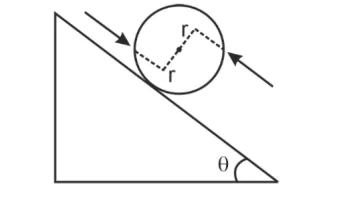
A solid sphere of mass 1 kg and radius 1 m rolls without slipping on a fixed inclined plane with an angle of inclination from the horizontal. Two forces of magnitude 1 N each, parallel to the incline, act on the sphere, both at distance r = 0.5 m from the center of the sphere, as shown in the figure. The acceleration of the sphere down the plane is ____ ms-2. (Take g = 10 m s-2.)
Correct Answer :
Solution :
The correct answer is 2.86 ms-2.
From the figure, a solid sphere rolls without slipping down a fixed inclined plane at angle . Two forces of 1 N each, both parallel to the incline and both at a perpendicular distance of r = 0.5 m from the center, act on the sphere. As visible in the diagram, one force points up the incline and the other points down the incline, with their lines of action separated by a distance 2r forming a couple. The two forces form a force couple: their net translational effect is zero, but they produce a combined net torque.
Step 1: Identify the given values.
Mass of sphere: m = 1 kg
Radius of sphere: R = 1 m
Angle of inclination: θ = 30°
Magnitude of each applied force: F = 1 N
Distance from center for each force: r = 0.5 m
g = 10 ms-2
Step 2: Calculate the moment of inertia of the solid sphere.
Step 3: Analyze the net torque from the two applied forces.
The two forces form a couple. As shown in the figure, one force acts up the incline at perpendicular distance r from the center, and the other acts down the incline at perpendicular distance r from the center. Both torques act in the same rotational direction (both oppose the clockwise rolling of the sphere down the incline).
Step 4: Write the translational equation of motion along the incline.
Forces along the incline: gravity component (mg sinθ) acts down, and friction force (f) from the surface acts up the incline. Since the two applied forces cancel each other translationally (net = 0), the translational equation is:
Step 5: Write the rotational equation of motion about the center.
Torques about the center: friction (f) acts at radius R and provides torque aiding rolling (opposing slip), while the couple from the two applied forces provides 1 N·m opposing rolling. Taking the rolling-down direction as positive:
Step 6: Apply the rolling without slipping condition.
For rolling without slipping: , so .
Substituting into equation (2):
Step 7: Solve for acceleration a.
Substitute equation (3) into equation (1):
Conclusion: The acceleration of the sphere down the inclined plane is 20/7 ≈ 2.86 ms-2. The key insight is that the two applied forces form a pure couple (zero net force, but a net torque of 1 N·m opposing rolling), which reduces the net acceleration compared to simple gravitational rolling where a = (5/7)g sinθ = (5/7)(10)(0.5) ≈ 3.57 ms-2. The opposing couple reduces this to approximately 2.86 ms-2.
Access expert-curated educational resources and study materials—completely free.
Create, conduct, and manage professional online assessments with Mindyard. Perfect for teachers and institutes.
Copyright © 2026 Mindyard. All Rights Reserved.