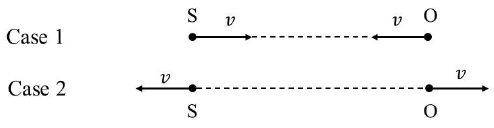
A source (S) of sound has frequency 240 Hz. When the observer (O) and the source move towards each other at a speed 𝑣 with respect to the ground (as shown in Case 1 in the figure), the observer measures the frequency of the sound to be 288 Hz. However, when the observer and the source move away from each other at the same speed 𝑣 with respect to the ground (as shown in Case 2 in the figure), the observer measures the frequency of sound to be 𝑛 Hz. The value of 𝑛 is _____.
Correct Answer :
Solution :
The correct answer is 200.
To find the frequency of sound measured by the observer in Case 2, we can apply the Doppler effect formula for sound waves. Let us define the variables involved:
- Let
be the original frequency of the source, which is given as 240 Hz.
- Let
be the speed of sound in the air.
- Let
be the speed of both the source and the observer relative to the ground.
- Let
be the frequency measured in Case 1 (288 Hz).
- Let
be the frequency measured in Case 2.
Analysis of the Image:
As shown in the diagram under Case 1, the source S (labeled as S) moves to the right towards the observer O (labeled as O), and the observer O moves to the left towards the source S, both at speed
relative to the ground. Under Case 2, the arrows indicate that the source S moves to the left and the observer O moves to the right, both moving away from each other at speed
.
Step 1: Formula for Case 1 (Moving Towards Each Other)
When the source and the observer move towards each other, the apparent frequency increases. The Doppler effect formula for this case is:
Substituting the given values into this equation:
We simplify this relation by dividing both sides by 24:
Cross-multiplying to find the relation between
and
:
Step 2: Formula for Case 2 (Moving Away From Each Other)
When the source and the observer move away from each other, the apparent frequency decreases. The Doppler effect formula for this case is:
Substituting
and the original source frequency
into the equation:
Simplifying the fraction:
Thus, the value of
is 200.
Access expert-curated educational resources and study materials—completely free.
Create, conduct, and manage professional online assessments with Mindyard. Perfect for teachers and institutes.
Copyright © 2026 Mindyard. All Rights Reserved.