
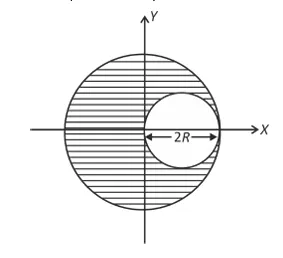
A sphere of radius R is cut from a larger solid sphere or radius 2R as shown in the figure. The ratio of the moment of inertia of the smaller sphere to that of the rest part of the sphere about the Y-axis is:
Solution :
Correct Answer: 7/57
Analysis of the Image:
Based on the provided illustration, we observe a coordinate system with axes labeled X and Y. The origin is located at the center of the larger solid sphere. The larger sphere has a radius of 2R (so its diameter spans from x = -2R to x = 2R). A smaller sphere of radius R is removed from the right side of the sphere. The diameter of this removed cavity is labeled as 2R with a double-headed arrow spanning from the origin x = 0 to the outer edge of the large sphere at x = 2R. The shaded region represents the remaining (rest) part of the sphere.
Step-by-Step Derivation:
Step 1: Relate the masses of the spheres using density
Let the uniform mass density of the sphere be .
The volume of a sphere of radius is given by .
For the smaller removed sphere of radius , its mass is:
For the complete larger solid sphere of radius , its mass is:
Step 2: Moment of inertia of the complete large sphere about the Y-axis
The moment of inertia of a uniform solid sphere of mass and radius about an axis passing through its center is .
For the complete sphere about the Y-axis:
Step 3: Moment of inertia of the smaller sphere about the Y-axis
The center of mass of the smaller sphere is located at a distance from the Y-axis.
Using the parallel axis theorem, the moment of inertia of this smaller sphere about the Y-axis is:
Step 4: Moment of inertia of the rest of the sphere
The moment of inertia of the remaining portion of the sphere is obtained by subtracting the moment of inertia of the cut-out section from the total moment of inertia:
Step 5: Calculate the ratio
The ratio of the moment of inertia of the smaller sphere to that of the rest part of the sphere about the Y-axis is:
Completely free for students. Educators & coaching institutes get 2 months free Pro trial to create tests.
Access unlimited practice questions, detailed step-by-step solutions, and exam study materials — completely free for students.
Create and conduct professional online assessments with AI question generation, tab proctoring, and comprehensive batch management.

A comprehensive JEE Advanced 2022 Paper 1 designed to help aspirants understand the examination pattern, difficulty level, and question trends of JEE Advanced. This paper covers important concepts from Physics, Chemistry, and Mathematics, featuring a balanced mix of conceptual, numerical, and advanced application-based questions. It helps students strengthen conceptual understanding, enhance analytical and problem-solving skills, and improve speed and accuracy. Ideal for practice, revision, self-assessment, previous year trend analysis, concept reinforcement, and time management, this paper is a valuable resource for effective JEE Advanced preparation.

A comprehensive JEE Advanced 2022 Paper 2 designed to help aspirants understand the examination pattern, difficulty level, and question trends of JEE Advanced. This paper covers important concepts from Physics, Chemistry, and Mathematics, featuring a balanced mix of conceptual, numerical, and advanced application-based questions. It helps students strengthen conceptual understanding, enhance analytical and problem-solving skills, and improve speed and accuracy. Ideal for practice, revision, self-assessment, previous year trend analysis, concept reinforcement, and time management, this paper is a valuable resource for effective JEE Advanced preparation.
Copyright © 2026 Combe Labs Private Limited. All Rights Reserved.


