A sprinkler shown in the figure rotates about its hinge point in a horizontal plane due to water flow discharged through its two exit nozzles.
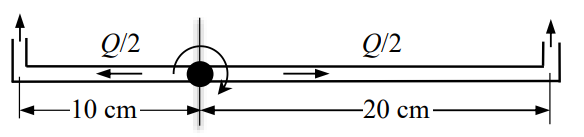
The total flow rate Q through the sprinkler is 1 litre/sec and the cross-sectional area of each exit nozzle is 1 cm2 . Assuming equal flow rate through both arms and a frictionless hinge, the steady state angular speed of rotation (in rad/s) of the sprinkler is ______ (correct to two decimal places).
Correct Answer :
Solution :
Based on the schematic diagram provided in the image, the sprinkler has a frictionless hinge and two arms of unequal lengths through which water is discharged:
- Left arm length, r1 = 10 cm = 0.1 m
- Right arm length, r2 = 20 cm = 0.2 m
- Total flow rate, Q = 1 L/s = 10-3 m3/s
- Cross-sectional area of each exit nozzle, A = 1 cm2 = 10-4 m2
Since the flow is divided equally between the two arms, the flow rate through each arm is:
The relative exit velocity of water () from each nozzle is:
Let the sprinkler rotate at a steady-state angular speed in the clockwise direction. From the diagram, the water jets from both nozzles exit in the upward direction.
Applying the conservation of angular momentum about the frictionless pivot point, the net external torque is zero. The sum of the exit angular momentum flux must be zero:
Since the mass flow rates are equal (), and accounting for the directions of the position vectors and absolute velocities:
- For the left arm, the nozzle is at position and the absolute velocity is .
- For the right arm, the nozzle is at position and the absolute velocity is .
This gives the torque balance equation:
Rearranging the equation to solve for the angular speed :
Substituting the values:
The magnitude of the steady-state angular speed of rotation is 10 rad/s.
The correct answer is 10.
Access expert-curated educational resources and study materials—completely free.
Create, conduct, and manage professional online assessments with Mindyard. Perfect for teachers and institutes.
Copyright © 2026 Mindyard. All Rights Reserved.