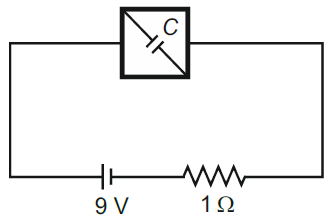
A square loop of resistance 16 Ω is connected with battery of 9 V and internal resistance of 1 Ω. In steady state, find energy stored in capacitor of capacity C = 4 μF as shown (at steady state current divides symmetrically)
Solution :
Correct Option: 25.92 μJ
Step-by-Step Explanation:
1. Determine the Resistance of the Sides of the Square Loop:
The total resistance of the square loop is given as .
Since the loop is a square consisting of four equal sides, the resistance of each side is:
2. Analyze the Loop at Steady State:
In the steady state, the capacitor behaves as an open circuit (infinite resistance), meaning no current flows through the diagonal branch containing the capacitor .
Let the connection points of the external circuit be at the midpoints of the left and right sides of the square:
- Let be the midpoint of the left side (connecting point).
- Let be the midpoint of the right side (connecting point).
- Let the corners of the square loop be labeled as: Bottom-Left (BL), Top-Left (TL), Top-Right (TR), and Bottom-Right (BR).
The current enters at and divides into two parallel paths to reach :
- Top Path:
The resistance of this path is:
- Bottom Path:
The resistance of this path is:
3. Calculate the Equivalent Resistance and Circuit Current:
The equivalent resistance of the parallel combination is:
With a battery of EMF and internal resistance , the total current in the circuit is:
By symmetry, the current divides equally between the top and bottom paths:
4. Calculate the Potential Difference across the Capacitor:
The capacitor is connected across the diagonal between the Bottom-Left corner (BL) and the Top-Right corner (TR).
Let us calculate the electric potentials at BL and TR relative to the entry node (assuming ):
- Potential at BL:
- Potential at TR (following the top path):
The potential difference across the capacitor is:
5. Find the Energy Stored in the Capacitor:
The energy stored in a capacitor of capacity is:
Completely free for students. Educators & coaching institutes get 2 months free Pro trial to create tests.
Access unlimited practice questions, detailed step-by-step solutions, and exam study materials — completely free for students.
Create and conduct professional online assessments with AI question generation, tab proctoring, and comprehensive batch management.

A comprehensive JEE Advanced 2022 Paper 1 designed to help aspirants understand the examination pattern, difficulty level, and question trends of JEE Advanced. This paper covers important concepts from Physics, Chemistry, and Mathematics, featuring a balanced mix of conceptual, numerical, and advanced application-based questions. It helps students strengthen conceptual understanding, enhance analytical and problem-solving skills, and improve speed and accuracy. Ideal for practice, revision, self-assessment, previous year trend analysis, concept reinforcement, and time management, this paper is a valuable resource for effective JEE Advanced preparation.

A comprehensive JEE Advanced 2022 Paper 2 designed to help aspirants understand the examination pattern, difficulty level, and question trends of JEE Advanced. This paper covers important concepts from Physics, Chemistry, and Mathematics, featuring a balanced mix of conceptual, numerical, and advanced application-based questions. It helps students strengthen conceptual understanding, enhance analytical and problem-solving skills, and improve speed and accuracy. Ideal for practice, revision, self-assessment, previous year trend analysis, concept reinforcement, and time management, this paper is a valuable resource for effective JEE Advanced preparation.
Copyright © 2026 Combe Labs Private Limited. All Rights Reserved.