
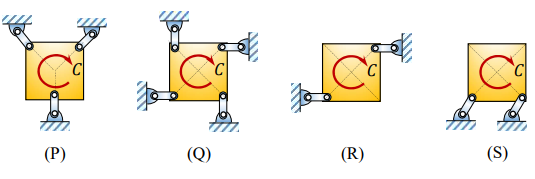
A square plate is supported in four different ways (configurations (P) to (S) as shown in the figure). A couple moment 𝐶 is applied on the plate. Assume all the members to be rigid and mass-less, and all joints to be frictionless. All support links of the plate are identical. The square plate can remain in equilibrium in its initial state for which one or more of the following support configurations?
Solution :
The correct options are: Configuration (Q), Configuration (R), and Configuration (S).
1. Fundamental Principles of Equilibrium:
For any rigid body to remain in static equilibrium, two conditions must be satisfied:
First, the vector sum of all external forces must be zero:
2. Nature of the Supports:
All support links are identical, massless, and pinned at both ends (frictionless joints). Therefore, each link acts as a two-force member. This means the force exerted by any link on the plate must act strictly along the line of action connecting its two end pins.
3. Configuration Analysis:
Configuration (P):
- The two top links are aligned with the diagonals of the square plate (as shown by the dashed diagonal lines). Their lines of action pass directly through the geometric center of the plate.
- The bottom link is vertical and attached at the center of the bottom edge of the plate. Its line of action also passes vertically through the geometric center of the plate.
- Because the lines of action of all three support forces intersect at a single point (the center of the plate), the moment created by these support forces about the center is zero:
Configuration (Q):
- This configuration has four links aligned along the edges of the plate (two vertical and two horizontal).
- Their lines of action do not intersect at a single point.
- The vertical links can exert equal and opposite forces to form a vertical force couple, and the horizontal links can form a horizontal force couple. Together, they can easily balance the clockwise couple C, meaning Configuration (Q) can remain in equilibrium.
Configuration (R):
- This configuration features two horizontal links attached at the bottom-left and top-right corners.
- The two links are parallel and separated by a perpendicular distance equal to the height of the plate.
- They can develop equal and opposite horizontal forces to produce a counter-clockwise restoring couple that directly balances the applied moment C. Therefore, Configuration (R) can remain in equilibrium.
Configuration (S):
- This configuration contains two parallel diagonal links at the bottom-left and bottom-right corners.
- Being parallel and non-collinear, they can develop equal and opposite forces along their parallel lines of action to form a restoring couple that balances the moment C. Thus, Configuration (S) can remain in equilibrium.
Completely free for students. Educators & coaching institutes get 2 months free Pro trial to create tests.
Access unlimited practice questions, detailed step-by-step solutions, and exam study materials — completely free for students.
Create and conduct professional online assessments with AI question generation, tab proctoring, and comprehensive batch management.

A comprehensive JEE Advanced 2022 Paper 1 designed to help aspirants understand the examination pattern, difficulty level, and question trends of JEE Advanced. This paper covers important concepts from Physics, Chemistry, and Mathematics, featuring a balanced mix of conceptual, numerical, and advanced application-based questions. It helps students strengthen conceptual understanding, enhance analytical and problem-solving skills, and improve speed and accuracy. Ideal for practice, revision, self-assessment, previous year trend analysis, concept reinforcement, and time management, this paper is a valuable resource for effective JEE Advanced preparation.

A comprehensive JEE Advanced 2022 Paper 2 designed to help aspirants understand the examination pattern, difficulty level, and question trends of JEE Advanced. This paper covers important concepts from Physics, Chemistry, and Mathematics, featuring a balanced mix of conceptual, numerical, and advanced application-based questions. It helps students strengthen conceptual understanding, enhance analytical and problem-solving skills, and improve speed and accuracy. Ideal for practice, revision, self-assessment, previous year trend analysis, concept reinforcement, and time management, this paper is a valuable resource for effective JEE Advanced preparation.
Copyright © 2026 Combe Labs Private Limited. All Rights Reserved.


