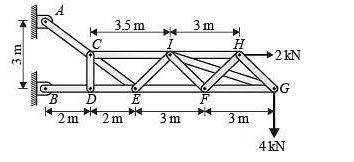
A structure, along with the loads applied on it, is shown in the figure. Self-weight of all the members is negligible and all the pin joints are friction-less. AE is a single member that contains pin C. Likewise, BE is a single member that contains pin D. Members GI and FH are overlapping rigid members. The magnitude of the force carried by member CI is ________ kN (in integer).
Correct Answer :
Correct answer is : 18
Solution :
The correct answer is 18.
Step 1: Understand the Geometry of the Members
We are given that:
- is a single straight member pinned at the wall support and the joint , and it contains the pin joint .
- is a single horizontal member pinned at the wall support and joint , containing the pin joint .
- The vertical distance between the wall supports and is .
- The horizontal distance and , so the total horizontal length .
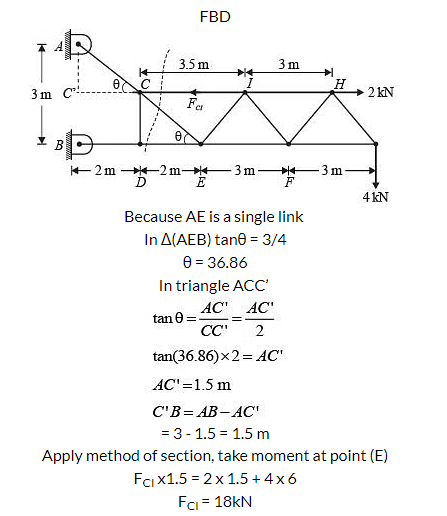
Let be the angle that the member makes with the horizontal member . From the right-angled triangle formed by the wall and the member (triangle ):
Let be the projection of the joint on the vertical wall . Since is directly above , the horizontal distance from the wall to is .
Using triangle :
Substituting :
Therefore, the height of joint (and the horizontal member ) above the bottom member is:
Step 2: Method of Sections
To find the force in member , we pass a section cut through the structure. The cut divides the truss into left and right portions by cutting through:
1. Member
2. Member (between joints and )
3. Member (between joints and )
Consider the equilibrium of the right-hand portion of the cut structure.
Because the members and are straight members pinned at joint , the internal forces transmitted at their cut sections must have lines of action that pass directly through the pin joint . Therefore, taking the sum of moments about point will eliminate the contribution of the forces in members and .
Step 3: Moment Equilibrium Equation about Joint E
Taking counter-clockwise moments as positive, the equations of equilibrium for the right-hand section about joint gives:
The forces contributing to the moment about are:
- The force in member acting horizontally at a vertical distance of (producing a counter-clockwise moment).
- The horizontal external load of at joint acting at a vertical distance of (producing a clockwise moment).
- The vertical external load of at joint acting at a horizontal distance of from (producing a clockwise moment).
Setting up the moment equation:
Simplify and solve for :
Thus, the magnitude of the force carried by member is 18 kN.
Access expert-curated educational resources and study materials—completely free.
Create, conduct, and manage professional online assessments with Mindyard. Perfect for teachers and institutes.
Copyright © 2026 Mindyard. All Rights Reserved.