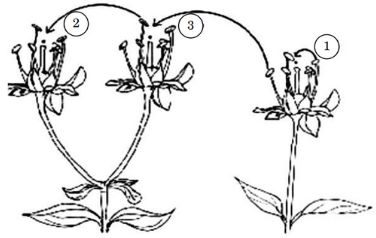
(a) Study the diagram given below showing the modes of pollination.
Answer the questions that follow.
i) The given diagram shows three methods of pollen transfer in plants. What are the technical terms used for pollen transfer methods '1', '2' and '3' ?
ii) How do the following plants achieve pollination successfully ?
1. Water lily
2.Vallisneria
iii) Flowering plants have developed many devices to avoid inbreeding depression. Explain one hereditary and one physiological device which helps plants to achieve this target.
or
(b) Observe the diagram given below showing the menstrual cycle of a normal human female.
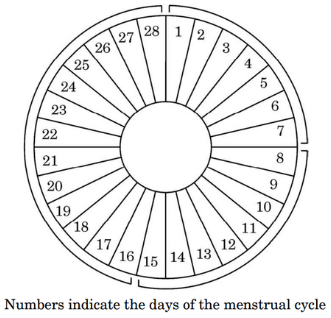
Answer the questions that follow :
i) What are the suitable technical terms used for the following ?
1. Days 1-7
2. Days 8-12
3. Days 16-28
4. Days 13-15
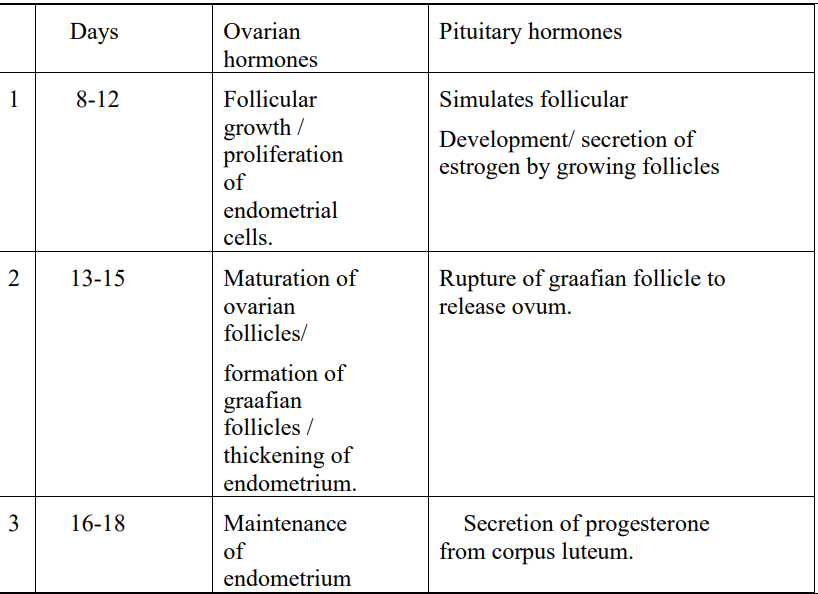
ii) Explain the role of ovarian and pituitary hormones during the following time periods :
1. Days 8-12
2. Days 13-15
3. Days 16-28
Correct Answer :
(a)
i)
1. Autogamy
2. Geitonogamy
3. Xenogamy
ii)
1. Water lily: pollinated by insects/wind.
2. Vallisneria : Female flowers on long stalks reach water surface male flowers or pollen released on water and carried by water current to female flowers to achieve pollination.
iii) Genetic : Self-incompatibility / prevents self-pollen (same flower or other flowers of same plant) from fertilizing the ovules by inhibiting pollen germination, pollen tube growth in pistil. Physiological : Pollen release and stigma receptivity are not synchronized, either pollen matures earlier and stigma later or pollen matures later than stigma.
or
(b)
i)
1. Menstrual period
2. Follicular phase/proliferative phase
3. Luteal phase/secretory phase
4. Ovulatory phase
ii)
Solution :
The correct answer/option is as follows:
(a)
i)
1. Autogamy
2. Geitonogamy
3. Xenogamy
ii)
1. Water lily: pollinated by insects/wind.
2. Vallisneria: Female flowers on long stalks reach the water surface; male flowers or pollen are released on the water surface and carried by water currents to the female flowers to achieve pollination.
iii)
Genetic (Hereditary): Self-incompatibility, which prevents self-pollen (from the same flower or other flowers of the same plant) from fertilizing the ovules by inhibiting pollen germination or pollen tube growth in the pistil.
Physiological: Pollen release and stigma receptivity are not synchronized; either pollen matures earlier and stigma later, or pollen matures later than stigma.
or
(b)
i)
1. Menstrual period
2. Follicular phase / proliferative phase
3. Luteal phase / secretory phase
4. Ovulatory phase
ii) The roles of ovarian and pituitary hormones corresponding to the table provided in the diagram (image_2.png):
1. Days 8-12: Ovarian hormones/activity lead to follicular growth and proliferation of endometrial cells, while pituitary hormones stimulate follicular development and the secretion of estrogen by growing follicles.
2. Days 13-15: Ovarian hormones/activity lead to the maturation of ovarian follicles, formation of Graafian follicles, and thickening of the endometrium, while pituitary hormones induce the rupture of the Graafian follicle to release the ovum (ovulation).
3. Days 16-28 (represented as 16-18 in the diagram): Ovarian hormones maintain the endometrium, while the pituitary/ovarian axis coordinates the secretion of progesterone from the corpus luteum.
Detailed Step-by-Step Explanation:
Part (a) Analysis:
i) Understanding the Modes of Pollination:
By studying the diagram showing the modes of pollination (image_0.png), we observe three distinct pathways for pollen transfer:
1. Pathway 1 (Autogamy): The arrow labeled '1' shows pollen transferring from the anther to the stigma of the same flower. This is known as autogamy (self-pollination).
2. Pathway 2 (Geitonogamy): The arrow labeled '2' shows pollen transferring from a flower to another flower located on the same plant (connected by the same branched stem). This is geitonogamy.
3. Pathway 3 (Xenogamy): The arrow labeled '3' shows pollen transferring from a flower of one plant to a flower of a different plant altogether. This is xenogamy (cross-pollination).
ii) Pollination Mechanisms in Water Lily and Vallisneria:
1. Water Lily: Although it is an aquatic plant, its flowers emerge above the surface of the water. Therefore, it is pollinated by terrestrial agents like insects or wind, rather than by water.
2. Vallisneria: This dioecious submerged aquatic plant uses water currents for pollination (ephydrophily). The female flower reaches the water surface via a long, coiled stalk. The male flowers or pollen grains are released onto the surface of the water and are carried passively by water currents until they make contact with the receptive stigma of the female flowers.
iii) Inbreeding Avoidance Devices:
To prevent inbreeding depression (loss of vigor due to self-pollination), plants have evolved several mechanisms:
1. Genetic Device (Self-incompatibility): This is an inherited genetic mechanism where the pistil recognizes and rejects pollen from the same flower or same plant. It inhibits pollen germination or pollen tube growth within the style, ensuring fertilization only occurs with genetically distinct pollen.
2. Physiological Device (Dichogamy / Non-synchrony): In this mechanism, pollen release and stigma receptivity do not occur at the same time. If the pollen matures and is released before the stigma becomes receptive (protandry), or if the stigma matures before the pollen is released (protogyny), self-pollination is physically prevented.
Part (b) Analysis:
i) Phases of the Menstrual Cycle:
The circular menstrual cycle diagram (image_1.png) represents a standard 28-day cycle divided into distinct segments:
1. Days 1-7 (Menstrual period): This is the initial phase marked by the breakdown of the endometrial lining and menstruation.
2. Days 8-12 (Follicular phase / Proliferative phase): During this phase, primary follicles in the ovary grow to become fully mature Graafian follicles, and the endometrium regenerates through proliferation.
3. Days 13-15 (Ovulatory phase): A short phase around the middle of the cycle when ovulation occurs.
4. Days 16-28 (Luteal phase / Secretory phase): The phase after ovulation where the ruptured Graafian follicle transforms into the corpus luteum, secreting large amounts of progesterone.
ii) Hormonal Interactions (referencing the table in image_2.png):
1. Days 8-12: Pituitary gonadotropins (FSH and LH) gradually increase, stimulating follicular growth and the secretion of estrogen by the growing follicles. Estrogen, in turn, stimulates the proliferation of the endometrial cells of the uterine wall.
2. Days 13-15: LH and FSH reach peak levels (LH surge). This pituitary hormone activity induces the rupture of the mature Graafian follicle, leading to the release of the ovum (ovulation). Ovarian changes include the complete maturation of follicles and maximum thickening of the endometrium.
3. Days 16-28 (Days 16-18 in the provided table): The remaining parts of the Graafian follicle transform into the corpus luteum, which secretes progesterone. Progesterone is essential for the maintenance and secretory functions of the endometrium, preparing it for possible implantation of a fertilized ovum.
Access expert-curated educational resources and study materials—completely free.
Create, conduct, and manage professional online assessments with Mindyard. Perfect for teachers and institutes.
Copyright © 2026 Mindyard. All Rights Reserved.
 Set - 3-1782888548748.webp)