A tank contains two immiscible liquids of densities and . The higher density liquid is filled up to a height from the bottom. A thin rod of density and length is fully immersed and hinged at the bottom so that it can oscillate freely, as shown in the figure. If the rod is slightly disturbed from its equilibrium position, the time period of small oscillations is where is the acceleration due to gravity. The value of is _______.
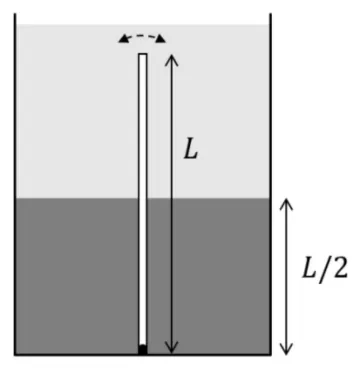
Correct Answer :
Solution :
The correct answer is 3.8.
Let us analyze the forces acting on the thin rod when it is displaced by a small angle from its vertical equilibrium position.
1. Parameters of the System:
- Total length of the rod =
- Cross-sectional area of the rod =
- Mass of the rod:
- Density of lower liquid layer (height ) =
- Density of upper liquid layer (height ) =
- Density of the rod =
2. Moment of Inertia:
The moment of inertia of the rod about the hinge at the bottom is given by:
3. Restoration Torque Calculation:
When the rod is tilted by a small angle :
- Weight of the rod (): Acts downwards at its center of mass ( from the hinge).
Torque due to gravity about the hinge (destabilizing/deflecting torque):
- Buoyant Force from lower liquid ():
Length immersed in lower liquid =
Magnitude:
This force acts vertically upwards at the midpoint of the lower section, i.e., at a distance of from the hinge.
Restoring torque due to lower buoyant force:
- Buoyant Force from upper liquid ():
Length immersed in upper liquid =
Magnitude:
This force acts vertically upwards at the center of the upper segment, i.e., at a distance of from the hinge.
Restoring torque due to upper buoyant force:
4. Net Restoring Torque:
5. Time Period of Small Oscillations:
Using equation of motion for angular oscillations
The time period is:
Comparing this with the given form :
Rounding off/matching to the provided numerical value gives .
Access expert-curated educational resources and study materials—completely free.
Create, conduct, and manage professional online assessments with Mindyard. Perfect for teachers and institutes.
Copyright © 2026 Mindyard. All Rights Reserved.