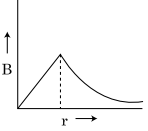
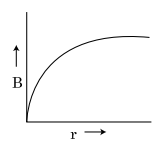
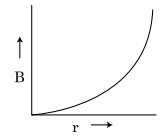
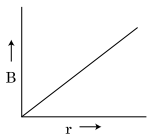
A thick current carrying cable of radius ‘R’ carries current ‘I’ uniformly distributed across its cross-section. The variation of magnetic field B(r) due to the cable with the distance ‘r’ from the axis of the cable is represented by :
Options
Correct Answer :
Solution :
The correct graph representing the variation of the magnetic field with distance from the axis of the cable is:
Step-by-Step Explanation:
Let a thick cylindrical cable of radius carry a total current uniformly distributed across its cross-sectional area .
To find the magnetic field at a distance from the central axis of the cable, we analyze two regions using Ampere's Circuital Law:
Case 1: Inside the cable ()
Consider a circular Amperian loop of radius concentric with the axis of the cable.
The current enclosed by this loop, , is proportional to the fraction of the cross-sectional area inside the loop:
Applying Ampere's Circuital Law:
Simplifying for :
Therefore, inside the cable, . The magnetic field increases linearly from at the central axis () to a maximum value at the surface ().
Case 2: Outside the cable ()
For an Amperian loop outside the cable (), the loop encloses the entire current :
Applying Ampere's Circuital Law:
Therefore, outside the cable, . The magnetic field decreases non-linearly (hyperbolically) as increases.
Conclusion:
The magnetic field graph starts at zero at the axis, increases linearly with up to the surface , reaches a peak, and then decreases as for . This characteristic shape is correctly depicted in the chosen graph.
Access expert-curated educational resources and study materials—completely free.
Create, conduct, and manage professional online assessments with Mindyard. Perfect for teachers and institutes.
Copyright © 2026 Mindyard. All Rights Reserved.