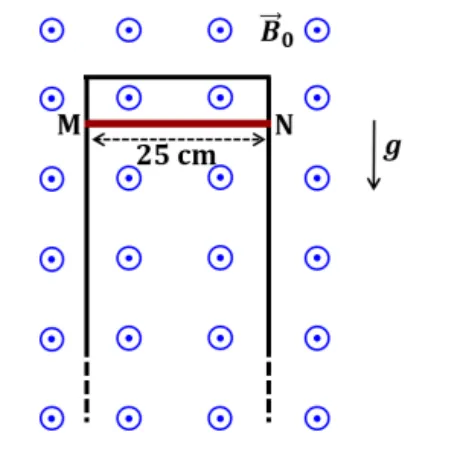
A thin conducting rod MN of mass 20 gm, length 25 cm and resistance 10 is held on frictionless, long, perfectly conducting vertical rails as shown in the figure. There is a uniform magnetic field B0 = 4 T directed perpendicular to the plane of the rod-rail arrangement. The rod is released from rest at time t = 0 and it moves down along the rails. Assume air drag is negligible. Match each quantity in List-I with an appropriate value from List-II, and choose the correct option.
| List-I | List-II |
|---|---|
| (P) | (1) |
| (Q) | (2) |
| (R) | (3) |
| (S) | (4) |
| (5) |
Correct Answer :
P → 3, Q → 4, R → 2, S → 5
Solution :
The correct option is P → 3, Q → 4, R → 2, S → 5.
1. Physics Fundamentals and Equations of Motion:
As shown in the image, a thin conducting rod MN of length l = 25 cm = 0.25 m and mass m = 20 g = 0.02 kg falls vertically under gravity downwards with acceleration g (taking g = 10 m/s2 or standard value as appropriate) in a uniform magnetic field B0 = 4 T directed out of the page (perpendicular to the plane of the rails).
When the rod moves downwards with speed v, an induced electromotive force (emf) is produced given by:
The induced current in the circuit (with total resistance R = 10 Ω) is:
This induced current experiences a magnetic force acting upwards (opposing the motion):
Here,
The equation of motion for the rod is:
Let constant .
Integrating with initial condition v(0) = 0 gives velocity as a function of time:
2. Step-by-Step Evaluation of List-I:
(S) Magnitude of terminal velocity of the rod:
Terminal velocity occurs when net acceleration is zero (i.e. magnetic force equals gravitational force):
Therefore, S → 5.
(P) Magnitude of induced emf at t = 0.2 s:
At t = 0.2 s:
Using (or ):
The magnitude of induced emf is:
Therefore, P → 3.
(Q) Magnitude of magnetic force at t = 0.2 s:
The magnetic force is:
Therefore, Q → 4.
(R) Power dissipated as heat at t = 0.2 s:
The power dissipated as heat in the resistor is:
Therefore, R → 2.
Matching Summary:
P → 3, Q → 4, R → 2, S → 5
Access expert-curated educational resources and study materials—completely free.
Create, conduct, and manage professional online assessments with Mindyard. Perfect for teachers and institutes.
Copyright © 2026 Mindyard. All Rights Reserved.