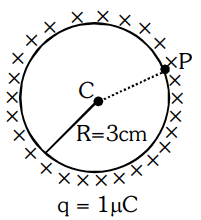
A thin spherical shell is charged by some source. The potential difference between the two points C and P (in V) shown in the figure is :
(Take 1/4π∈0 = 9 × 10⁹SI Units)
Solution :
For a thin spherical shell that carries a total charge \(Q\) uniformly distributed over its surface, the electric potential at any point on the surface is
where \(R\) is the radius of the shell and \(1/4\pi\varepsilon_{0}=9\times10^{9}\ \text{SI}\).
Because the shell is a conductor, the electric field inside the cavity of the shell is zero. Consequently the electric potential inside the cavity is the same everywhere and equals the surface potential:
In the figure the two points \(C\) and \(P\) are both located on the shell (or one on the surface and the other inside the cavity). Since the potential is constant throughout the shell and its interior, the potential difference between them is
Thus the required potential difference is zero volts.
Completely free for students. Educators & coaching institutes get 2 months free Pro trial to create tests.
Access unlimited practice questions, detailed step-by-step solutions, and exam study materials — completely free for students.
Create and conduct professional online assessments with AI question generation, tab proctoring, and comprehensive batch management.

A comprehensive JEE Advanced 2022 Paper 1 designed to help aspirants understand the examination pattern, difficulty level, and question trends of JEE Advanced. This paper covers important concepts from Physics, Chemistry, and Mathematics, featuring a balanced mix of conceptual, numerical, and advanced application-based questions. It helps students strengthen conceptual understanding, enhance analytical and problem-solving skills, and improve speed and accuracy. Ideal for practice, revision, self-assessment, previous year trend analysis, concept reinforcement, and time management, this paper is a valuable resource for effective JEE Advanced preparation.

A comprehensive JEE Advanced 2022 Paper 2 designed to help aspirants understand the examination pattern, difficulty level, and question trends of JEE Advanced. This paper covers important concepts from Physics, Chemistry, and Mathematics, featuring a balanced mix of conceptual, numerical, and advanced application-based questions. It helps students strengthen conceptual understanding, enhance analytical and problem-solving skills, and improve speed and accuracy. Ideal for practice, revision, self-assessment, previous year trend analysis, concept reinforcement, and time management, this paper is a valuable resource for effective JEE Advanced preparation.
Copyright © 2026 Combe Labs Private Limited. All Rights Reserved.