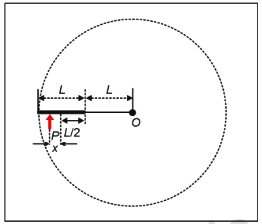
A thin uniform rod of length 𝐿 and certain mass is kept on a frictionless horizontal table with a massless string of length 𝐿 fixed to one end (top view is shown in the figure). The other end of the string is pivoted to a point O. If a horizontal impulse 𝑃 is imparted to the rod at a distance 𝑥 = 𝐿/𝑛 from the mid-point of the rod (see figure), then the rod and string revolve together around the point O, with the rod remaining aligned with the string. In such a case, the value of 𝑛 is _____.
Correct Answer :
Solution :
The correct answer is 18.
Step-by-Step Explanation:
1. Understanding the system configuration and kinematics:
Let the pivot be at the origin . The massless string of length connects the pivot to the inner end of the rod. The thin uniform rod of length and mass is aligned with the string.
Therefore, the rod lies along the radial direction from distance to from the pivot .
The center of mass (CM) of the uniform rod is at its mid-point, which is at a distance:
from the pivot .
Since the rod and string revolve together around point with the rod remaining aligned with the string, the motion immediately after the impulse is a pure rotation about the pivot with an angular velocity .
For this pure rotation about , the velocity of the center of mass of the rod () is related to the angular velocity by:
— (Equation 1)
2. Analyzing the impulses:
A horizontal impulse is applied perpendicular to the rod at a distance from the center of mass.
Since the string is massless and remains aligned radially along the line of the rod, it can only exert a tension force (and thus a tension impulse) along its length (radial direction). It cannot exert any transverse (perpendicular) force or impulse on the rod.
Consequently, the only transverse impulse acting on the rod is the applied impulse .
3. Applying the equations of impulse and momentum:
For the translation of the center of mass in the transverse direction:
— (Equation 2)
For the rotation of the rod about its center of mass:
The angular impulse about the center of mass is . This must equal the change in angular momentum about the center of mass:
where is the moment of inertia of the uniform rod about its center of mass.
Thus:
— (Equation 3)
4. Finding the value of n:
Substitute the expressions for (Equation 2) and (Equation 3) into Equation 1:
Access expert-curated educational resources and study materials—completely free.
Create, conduct, and manage professional online assessments with Mindyard. Perfect for teachers and institutes.
Copyright © 2026 Mindyard. All Rights Reserved.