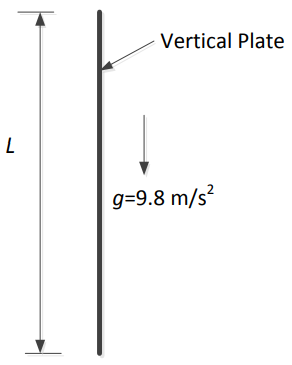
A thin vertical flat plate of height L, and infinite width perpendicular to the plane of the figure, is losing heat to the surroundings by natural convection. The temperatures of the plate and the surroundings, and the properties of the surrounding fluid, are constant. The relationship between the average Nusselt and Rayleigh numbers is given as Nu = K Ra¼, where K is a constant. The length scales for Nusselt and Rayleigh numbers are the height of the plate. The height of the plate is increased to 16L keeping all other factors constant.
If the average heat transfer coefficient for the first plate is h1 and that for the second plate is h2, the value of the ratio h1/h2 is____________.
Correct Answer :
Solution :
The correct answer is 2.
Step-by-step Explanation:
As shown in the provided schematic, we have a vertical plate of height L under the influence of gravity (with pointing vertically downwards). The plate is losing heat to the surrounding fluid by natural convection.
First, let us recall the definitions of the average Nusselt number () and Rayleigh number () using the height of the plate as the characteristic length scale:
where:
• is the average heat transfer coefficient,
• is the height of the plate,
• is the thermal conductivity of the fluid.
Since all fluid properties and temperatures are constant, we can establish the proportionality:
The Rayleigh number is defined as:
Since gravity , the volumetric thermal expansion coefficient , the temperature difference , kinematic viscosity , and thermal diffusivity are all held constant, the Rayleigh number is proportional to the cube of the plate height:
We are given the relationship between the average Nusselt and Rayleigh numbers as:
Substituting the proportionalities of and into this relation:
Solving for the average heat transfer coefficient in terms of :
Therefore, the ratio of the average heat transfer coefficients for the first plate ( with height ) and the second plate ( with height ) is:
Access expert-curated educational resources and study materials—completely free.
Create, conduct, and manage professional online assessments with Mindyard. Perfect for teachers and institutes.
Copyright © 2026 Mindyard. All Rights Reserved.