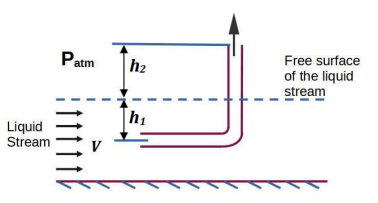
A tube of uniform diameter D is immersed in a steady flowing inviscid liquid stream of velocity V, as shown in the figure. Gravitational acceleration is represented by 𝑔. The volume flow rate through the tube is ______.
Correct Answer :
Solution :
The correct option is:
Step-by-Step Derivation and Explanation:
1. Identify the reference points and parameters from the diagram:
Let us analyze the system shown in the figures:
- The liquid stream flows horizontally with a steady velocity .
- The free surface of the liquid stream is exposed to the atmosphere, where the pressure is .
- Point 1 is chosen at the inlet of the submerged tube, which is at a depth of below the free surface.
- Point 2 is chosen at the exit of the tube, which is open to the atmosphere and situated at a height of above the free surface.
- The tube has a uniform diameter . Thus, by the continuity equation, the velocity of the fluid inside the tube remains constant throughout, meaning .
2. Bernoulli's Equation between the upstream stream and the tube inlet (Point 1):
Consider an upstream point at the same elevation as the tube inlet (depth ). The pressure at this upstream point is hydrostatic:
The flow velocity at the upstream point is . Applying Bernoulli's equation along the streamline from the upstream flow to the tube inlet (Point 1):
Substituting into the equation:
---- (Equation 1)
3. Bernoulli's Equation along the tube (Point 1 to Point 2):
Now, apply Bernoulli's equation inside the tube from the inlet (Point 1) to the exit (Point 2):
Since the tube has a uniform cross-section, the velocity inside is constant, so . The exit at Point 2 is open to the atmosphere, so . The elevation difference is .
Substituting these values, the equation simplifies to:
---- (Equation 2)
4. Solve for flow velocity inside the tube:
Substitute the expression for from Equation 2 into Equation 1:
Subtracting from both sides gives:
Rearranging to solve for the velocity inside the tube :
Multiplying by and taking the square root:
5. Calculate the volume flow rate:
The volume flow rate is the product of the tube's cross-sectional area and the fluid velocity inside:
Since the cross-sectional area for a tube of uniform diameter is :
Access expert-curated educational resources and study materials—completely free.
Create, conduct, and manage professional online assessments with Mindyard. Perfect for teachers and institutes.
Copyright © 2026 Mindyard. All Rights Reserved.