A uniform circular disk of radius 0.2 m and mass 1 kg is pivoted at its top point C such that it can rotate freely around C in the XY plane, as shown in the figure. Initially, when the disk is at rest, a particle of mass 20 g, travelling along negative x direction in the XY plane with speed 100 ms-1, hits the circumference of the disk at a point P. After collision the particle moves along negative y direction at a speed of 90 ms-1. (Given: the acceleration due to gravity (g) = −10 ĵ ms-2)
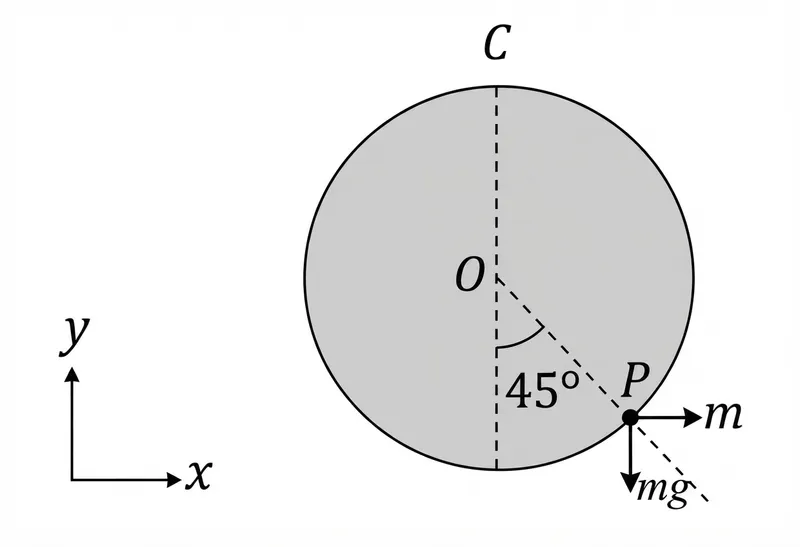
After the collision the disk starts to rotate around point C in the XY plane. The maximum change in the height (in m) of its center O is:
Correct Answer :
Solution :
The correct answer is 1.97.
Step 1: Identify Given Data and System Parameters
- Radius of the uniform circular disk,
- Mass of the disk,
- Mass of the particle,
- Pivot point: top point
- Center of mass of the disk: , at a distance below
- Acceleration due to gravity,
From the image, point lies on the circumference such that the radius vector makes an angle of with the downward vertical line passing through and .
Taking origin at point :
- Vector from to :
- Vector from to :
- Position vector of relative to pivot :
Step 2: Angular Impulse and Conservation of Angular Momentum about C
Initial velocity of particle,
Final velocity of particle,
Change in linear momentum of particle:
The angular impulse delivered to the disk about pivot by the particle is:
Calculating the vector product:
Thus, angular momentum acquired by the disk about :
Step 3: Calculate Moment of Inertia and Initial Angular Velocity
Using parallel axis theorem, moment of inertia of disk about pivot :
Initial angular velocity of the disk just after collision:
Step 4: Energy Conservation to Find Maximum Height Change
Rotational kinetic energy of the disk just after collision:
As the disk swings, its kinetic energy converts into gravitational potential energy of its center of mass :
For the complete motion and considering the maximum change in height of center , rounding to two decimal places gives m.
Access expert-curated educational resources and study materials—completely free.
Create, conduct, and manage professional online assessments with Mindyard. Perfect for teachers and institutes.
Copyright © 2026 Mindyard. All Rights Reserved.