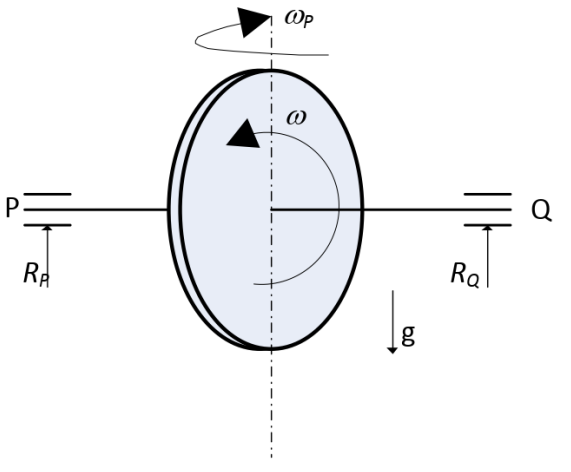
A uniform disc with radius r and a mass of m kg is mounted centrally on a horizontal axle of negligible mass and length of 1.5r. The disc spins counter-clockwise about the axle with angular speed ω, when viewed from the right-hand side bearing, Q. The axle precesses about a vertical axis at ωp = ω/10 in the clockwise direction when viewed from above. Let RP and RQ (positive upwards) be the resultant reaction forces due to the mass and the gyroscopic effect, at bearings P and Q, respectively. Assuming ω2r = 300 m/s2 and g = 10 m/s2, the ratio of the larger to the smaller bearing reaction force (considering appropriate signs) is ______ .
Correct Answer :
Solution :
Correct Answer: The ratio of the larger to the smaller bearing reaction force is -3.
Let's analyze the system step-by-step to find the bearing reactions at P and Q due to gravity and the gyroscopic couple:
1. Parameters given in the problem and diagram:
Mass of the disc, kg
Radius of the disc,
Length of the horizontal axle,
Angular speed of spin, (counter-clockwise when viewed from the right-hand bearing, Q)
Angular speed of precession, (clockwise when viewed from above)
Given parameters: and acceleration due to gravity,
2. Reactions due to the weight of the disc:
Since the disc is mounted centrally on the horizontal axle of negligible mass, the gravitational force acts downwards at the center of the axle. Due to symmetry, the reaction force at each bearing directed upwards is:
3. Gyroscopic Couple (C):
The mass moment of inertia of the disc about the polar axis is:
The magnitude of the gyroscopic couple is given by:
Substitute the given values into the formula:
Given that :
4. Bearing reactions due to the reactive gyroscopic couple:
Applying the right-hand rule for gyroscopic motion:
- The spin angular velocity vector points from P to Q (to the right).
- The precession angular velocity vector points vertically downwards.
- This results in a reactive gyroscopic couple that acts in a direction tending to lift the bearing at Q and press down the bearing at P.
Let be the magnitude of the reaction forces at the bearings P and Q due to this couple:
Therefore, the reaction forces due to the gyroscopic effect are:
At Q (upward):
At P (downward):
5. Total reactions at bearings P and Q:
Adding the gravitational and gyroscopic components:
6. Ratio of the reaction forces:
The ratio of the larger bearing reaction force to the smaller bearing reaction force is:
Access expert-curated educational resources and study materials—completely free.
Create, conduct, and manage professional online assessments with Mindyard. Perfect for teachers and institutes.
Copyright © 2026 Mindyard. All Rights Reserved.