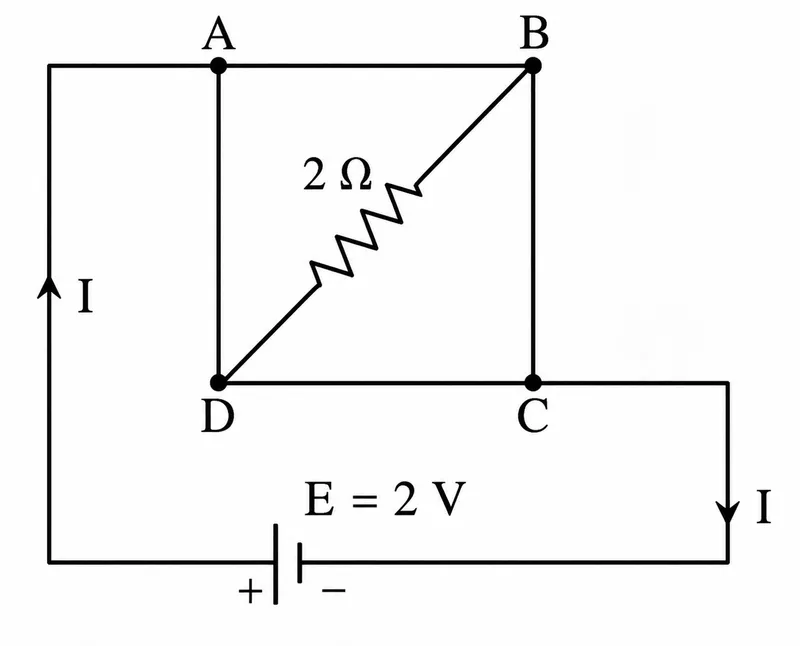
A uniform metallic wire having resistance 4 Ω is bent to form a square loop (ABCD). A resistance of 2 Ω is connected between points B and D and a battery of 2 V is connected across points A and C as shown in the figure. Now the amount of current (I) is: ____.
Correct Answer :
2 A
Solution :
Each side of the square loop is made from the uniform wire whose total resistance is 4 Ω, so the resistance of each side is
The circuit therefore has resistances:
AB = BC = CD = DA = 1 Ω and the diagonal resistor BD = 2 Ω.
The 2 V battery is connected across the opposite corners A and C. We assign the node potentials
and let the unknown potentials at B and D be \(V_B\) and \(V_D\).
Apply Kirchhoff’s current law at node B (sum of currents leaving B is zero):
Multiplying by 2 gives
Apply KCL at node D:
Multiplying by 2 gives
Solving equations (1) and (2) simultaneously:
From (1) \(V_D = 5V_B - 4\).
Substitute into (2):
Then
Thus the potentials at B and D are both 1 V.
The total current supplied by the battery is the sum of the currents on the two branches that leave node A:
Therefore, the amount of current flowing through the circuit is
Access expert-curated educational resources and study materials—completely free.
Create, conduct, and manage professional online assessments with Mindyard. Perfect for teachers and institutes.
Copyright © 2026 Mindyard. All Rights Reserved.