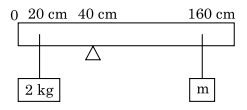
A uniform rod of length 200 cm and mass 500 g is balanced on a wedge placed at 40 cm mark. A mass of 2 kg is suspended from the rod at 20 cm and another unknown mass ‘m’ is suspended from the rod at 160 cm mark as shown in the figure. Find the value of ‘m’ such that the rod is in equilibrium. (g=10 m/s2)
Correct Answer :
1/12 kg
Solution :
The correct answer is 1/12 kg.
To find the value of the unknown mass such that the rod is in rotational equilibrium, we apply the principle of moments (torque equilibrium) about the wedge (pivot) located at the 40 cm mark. For the rod to remain balanced, the total anticlockwise torque about the pivot must equal the total clockwise torque about the pivot.
Let us analyze the system using the information given in the question and the labels visible in the image:
1. Wedge (Pivot Point): Positioned at the 40 cm mark.
2. Left Suspended Mass: A mass of 2 kg is suspended at the 20 cm mark.
3. Uniform Rod: The rod has a length of 200 cm and a mass of 500 g (which is ). Because the rod is uniform, its center of gravity is located at its geometric midpoint, which is the 100 cm mark.
4. Right Suspended Mass: An unknown mass is suspended at the 160 cm mark.
Now, we calculate the perpendicular distances from each force to the pivot at 40 cm:
- Distance of the 2 kg mass from the pivot:
- Distance of the rod's center of gravity (0.5 kg) from the pivot:
- Distance of the unknown mass from the pivot:
Next, we determine the direction of rotation each force tends to cause:
- The 2 kg mass lies to the left of the pivot, producing an anticlockwise torque.
- The weight of the rod (at 100 cm) and the unknown mass (at 160 cm) lie to the right of the pivot, producing clockwise torques.
For equilibrium, we write the torque balance equation:
Since the acceleration due to gravity is a common factor on both sides of the equation, we can cancel it out:
Solving for :
Thus, the value of the unknown mass required to keep the rod in equilibrium is 1/12 kg.
Access expert-curated educational resources and study materials—completely free.
Create, conduct, and manage professional online assessments with Mindyard. Perfect for teachers and institutes.
Copyright © 2026 Mindyard. All Rights Reserved.