
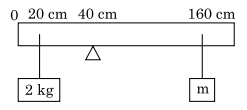
A uniform rod of length 200 cm and mass 500 g is balanced on a wedge placed at 40 cm mark. A mass of 2 kg is suspended from the rod at 20 cm and another unknown mass ‘m’ is suspended from the rod at 160 cm mark as shown in the figure. Find the value of ‘m’ such that the rod is in equilibrium. (g=10 m/s2)
Solution :
The problem provides a uniform rod of length and mass . The rod is supported at the mark (the wedge). A known mass of hangs at the mark, and an unknown mass hangs at the mark. We must find so that the rod is in equilibrium (net torque about the support is zero). The acceleration due to gravity is .
First, identify the distances of each force from the pivot (the wedge at ).
All forces act downward, producing torques about the pivot. torques that tend to rotate the rod clockwise are taken as positive; those that tend to rotate it anticlockwise are taken as negative.
Calculate each torque (force × distance). Use for each mass.
Clockwise torques (right‑hand side):
Anticlockwise torque (left‑hand side):
For equilibrium the sum of clockwise torques equals the sum of anticlockwise torques:
Solve for :
Thus the unknown mass that balances the rod is 1/12 kg, which matches the given correct option.
Completely free for students. Educators & coaching institutes get 2 months free Pro trial to create tests.
Access unlimited practice questions, detailed step-by-step solutions, and exam study materials — completely free for students.
Create and conduct professional online assessments with AI question generation, tab proctoring, and comprehensive batch management.

A comprehensive JEE Advanced 2022 Paper 1 designed to help aspirants understand the examination pattern, difficulty level, and question trends of JEE Advanced. This paper covers important concepts from Physics, Chemistry, and Mathematics, featuring a balanced mix of conceptual, numerical, and advanced application-based questions. It helps students strengthen conceptual understanding, enhance analytical and problem-solving skills, and improve speed and accuracy. Ideal for practice, revision, self-assessment, previous year trend analysis, concept reinforcement, and time management, this paper is a valuable resource for effective JEE Advanced preparation.

A comprehensive JEE Advanced 2022 Paper 2 designed to help aspirants understand the examination pattern, difficulty level, and question trends of JEE Advanced. This paper covers important concepts from Physics, Chemistry, and Mathematics, featuring a balanced mix of conceptual, numerical, and advanced application-based questions. It helps students strengthen conceptual understanding, enhance analytical and problem-solving skills, and improve speed and accuracy. Ideal for practice, revision, self-assessment, previous year trend analysis, concept reinforcement, and time management, this paper is a valuable resource for effective JEE Advanced preparation.
Copyright © 2026 Combe Labs Private Limited. All Rights Reserved.


