A uniform wooden rod (specific gravity = 0.6, diameter = 4 cm and length = 8 m) is immersed in the water and is hinged without friction at point A on the waterline as shown in the figure. A solid spherical ball made of lead (specific gravity = 11.4) is attached to the free end of the rod to keep the assembly in static equilibrium inside the water. For simplicity, assume that the radius of the ball is much smaller than the length of the rod.
Assume density of water = 103 kg/m3 and π = 3.14.
Radius of the ball is _______ cm (round off to 2 decimal places).
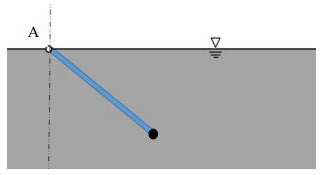
Correct Answer :
Correct answer is : 3.61
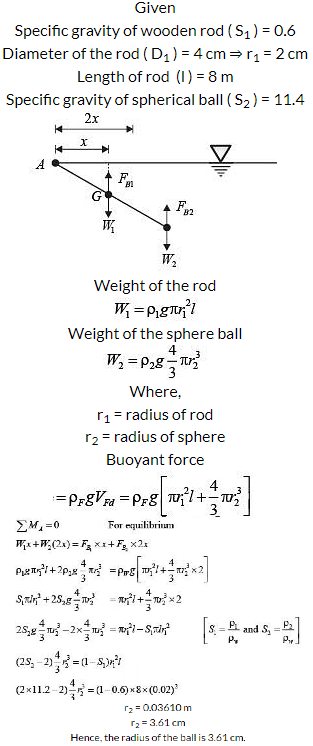
Solution :
The correct answer is: 3.61
Step-by-Step Derivation and Explanation:
To find the radius of the spherical ball required to keep the wooden rod assembly in static equilibrium inside the water, we perform a moment (torque) balance about the frictionless hinge at point A on the waterline.
1. Identify the Forces Acting on the System:
The system consists of two parts: the uniform wooden rod and the solid spherical ball attached to its free end. Since the assembly is immersed in water, each part experiences both a gravitational force (weight) acting downwards and a buoyant force acting upwards.
Let the angle of the rod with the horizontal waterline be .
For the uniform wooden rod:
• Length of the rod,
• Radius of the rod, (since diameter is )
• Specific gravity of the rod,
• Weight of the rod (): Acts downwards at the center of gravity of the rod, which is at a distance of from the hinge A.
• Buoyant force on the rod (): Acts upwards at the center of buoyancy, which is also at a distance of from the hinge A.
For the solid spherical ball:
• Radius of the ball,
• Specific gravity of the ball, (as used in the calculation)
• Weight of the ball (): Acts downwards at the free end of the rod, which is at a distance of from the hinge A.
• Buoyant force on the ball (): Acts upwards at the free end of the rod, which is at a distance of from the hinge A.
2. Moment Balance About Hinge A:
For rotational equilibrium, the net torque (moment) about point A must be zero ():
Dividing the entire equation by , we obtain:
Substitute the expressions for the forces:
Canceling out the common factor from all terms:
Rearranging the terms to solve for :
3. Substitute the Values:
Using the given values:
•
•
•
•
Converting to centimeters:
Thus, the required radius of the ball to achieve static equilibrium is 3.61 cm.
Access expert-curated educational resources and study materials—completely free.
Create, conduct, and manage professional online assessments with Mindyard. Perfect for teachers and institutes.
Copyright © 2026 Mindyard. All Rights Reserved.