A vector field
𝐁(𝑥, 𝑦, 𝑧) = 𝑥 𝑖̂+ 𝑦 ĵ− 2𝑧 k̂
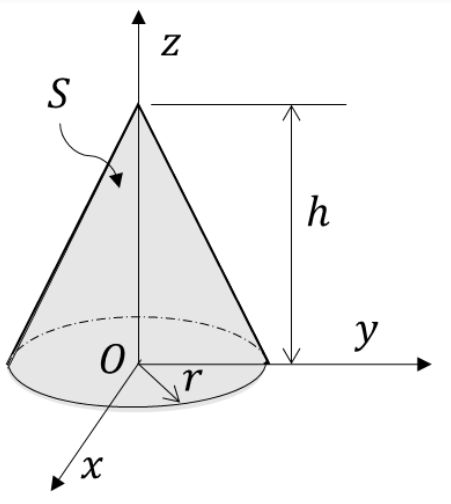
is defined over a conical region having height ℎ = 2, base radius 𝑟 = 3 and axis along z, as shown in the figure. The base of the cone lies in the x-y plane and is centered at the origin.
If 𝒏 denotes the unit outward normal to the curved surface 𝑆 of the cone, the value of the integral
∫s𝐁 S ⋅ 𝒏 dS equals _________ . (Answer in integer)
Correct Answer :
0
-1716315970964.png)
Solution :
The correct answer is 0.
Step-by-step Explanation:
1. Understanding the Geometry and Vector Field from the Diagram
As shown in the first image, we have a conical region with height , base radius , and its axis along the z-axis. The base of the cone, centered at the origin , lies in the x-y plane (where ). The curved surface is denoted by .
The given vector field is:
2. Applying the Gauss Divergence Theorem
To find the flux through the curved surface , we can define a closed surface bounding the conical volume . The total boundary of the volume consists of two parts:
- The curved surface
- The flat circular base at the bottom ()
By the Gauss Divergence Theorem, the net outward flux of the vector field through the entire closed surface is equal to the volume integral of the divergence of over the enclosed volume :
3. Calculating the Divergence of the Vector Field
Let us find the divergence of :
Evaluating the partial derivatives:
Since the divergence is zero everywhere, the volume integral is:
4. Evaluating Flux through the Circular Base
The base lies in the x-y plane where . The unit outward normal vector pointing away from the conical volume at the base is directed in the negative z-direction:
Taking the dot product of the vector field with gives:
Evaluating this expression at the base where yields:
Therefore, the flux through the base of the cone is:
5. Computing Flux through the Curved Surface
Substituting these values back into the Gauss Divergence Theorem equation:
Which simplifies to:
Access expert-curated educational resources and study materials—completely free.
Create, conduct, and manage professional online assessments with Mindyard. Perfect for teachers and institutes.
Copyright © 2026 Mindyard. All Rights Reserved.