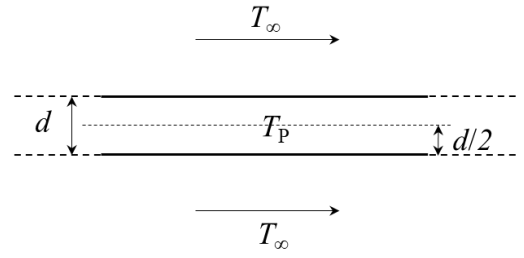
A very large metal plate of thickness 𝑑 and thermal conductivity 𝑘 is cooled by a stream of air at temperature 𝑇∞ = 300 K with a heat transfer coefficient ℎ, as shown in the figure. The centerline temperature of the plate is TP. In which of the following case(s) can the lumped parameter model be used to study the heat transfer in the metal plate?
Correct Answer :
ℎ = 100 Wm-2K -1 , k = 1000 Wm-1K -1 , 𝑑 = 1 mm, TP = 325 K
Solution :
The correct option is:
ℎ = 100 Wm-2K-1, k = 1000 Wm-1K-1, 𝑑 = 1 mm, TP = 325 K
Step-by-Step Explanation:
1. Criterion for Lumped Parameter Analysis:
The lumped parameter model (also known as lumped heat capacity analysis) assumes that the temperature within the solid body is spatially uniform at any instant during the heat transfer process. This assumption is valid when the resistance to heat conduction within the body is much smaller than the resistance to heat convection at the surface of the body. Quantitatively, this condition is satisfied when the Biot number () is less than 0.1:
2. Formula for Biot Number:
The Biot number is defined as:
where:
- h is the convective heat transfer coefficient ()
- k is the thermal conductivity of the metal plate ()
- is the characteristic length of the body (m)
3. Determining the Characteristic Length ():
The characteristic length is calculated as the ratio of the volume of the body to its surface area:
From the provided diagram, the plate has a thickness d and is cooled symmetrically by a stream of air at temperature on both its top and bottom surfaces. The centerline is at temperature , and the distance from the centerline to either surface is .
Let A be the surface area of one face of the plate. The total surface area exposed to heat transfer is , and the volume is . Therefore:
4. Evaluating the Biot Number for the Correct Option:
Given parameters in the correct option:
- Heat transfer coefficient,
- Thermal conductivity,
- Thickness of the plate,
First, compute the characteristic length:
Now, calculate the Biot number:
Since the calculated Biot number is:
The Biot number is significantly smaller than the threshold of 0.1. This indicates that the internal conductive thermal resistance of the metal plate is negligible compared to the external convective thermal resistance. Hence, the lumped parameter model can be accurately used to study the heat transfer in this case.
Access expert-curated educational resources and study materials—completely free.
Create, conduct, and manage professional online assessments with Mindyard. Perfect for teachers and institutes.
Copyright © 2026 Mindyard. All Rights Reserved.