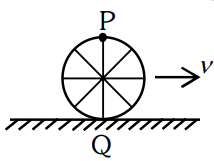
A wheel of a bullock cart is rolling on a level road as shown in the figure below. If its linear speed is v in the direction shown, which one of the following options is correct (P and Q are any highest and lowest points on the wheel, respectively) ?
Correct Answer :
Point P moves faster than point Q.
Solution :
In the diagram the wheel rolls to the right with a linear (translational) speed . Point P is the highest point on the rim, while point Q is the lowest point (the point of contact with the road).
For a wheel that rolls without slipping, the center C of the wheel moves with the same linear speed . The angular speed of the wheel is related to the linear speed by
, where is the wheel’s radius.
The velocity of any point on the rim is the vector sum of the translational velocity of the centre and the rotational velocity due to the spin:
Here is the radius vector from the centre to the point.
At the top point P, the radius vector points upward. The rotational velocity is horizontal and directed to the right, the same direction as the translational motion. Its magnitude is (because ). Therefore the total speed of P is
i.e., twice the linear speed of the wheel.
At the bottom point Q, the radius vector points downward, so the rotational velocity is to the left, opposite the translational motion. Its magnitude is also , and it cancels the translational velocity:
Thus point Q is instantaneously at rest with respect to the ground.
Consequently, the top point P moves faster than the bottom point Q. This matches the correct option given.
Access expert-curated educational resources and study materials—completely free.
Create, conduct, and manage professional online assessments with Mindyard. Perfect for teachers and institutes.
Copyright © 2026 Mindyard. All Rights Reserved.