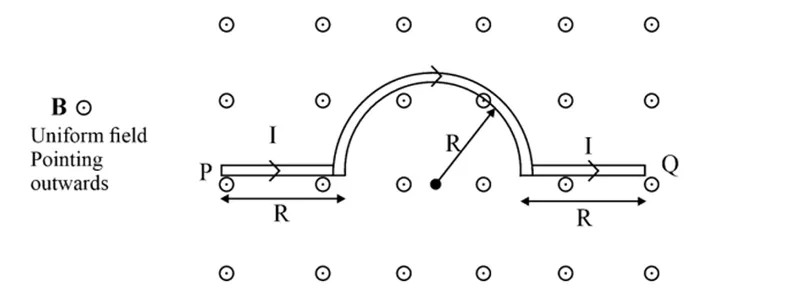
A wire carrying current I, bent as shown in the figure, is placed in a uniform mag netic field B that emerges normally out from the plane of the figure. The force on this wire is ________.
Fill in the blank with the correct answer from the options given below.
Correct Answer :
4BIR, directed vertically downward
Solution :
The correct option is 4BIR, directed vertically downward.
1. Understanding the Magnetic Force on a Current-Carrying Wire:
When a wire of any arbitrary shape carrying a current is placed in a uniform magnetic field , the net magnetic force acting on the wire is equivalent to the force acting on a straight wire connecting its endpoints. The formula is:
where:
• is the electric current in the wire,
• is the effective length vector, which is the displacement vector pointing directly from the starting point P to the ending point Q, and
• is the uniform magnetic field vector.
2. Analyzing the Geometry of the Wire:
Looking at the provided diagram, the wire is bent into three distinct sections:
• A left horizontal straight segment of length .
• A central semicircular arc of radius . The horizontal distance between the start and end of this semicircle is its diameter, which is equal to .
• A right horizontal straight segment of length .
3. Calculating the Effective Length Vector:
The net displacement vector starts at P and ends at Q along a straight horizontal path. The magnitude of this effective length vector is the sum of the horizontal spans of the three parts:
If we define the horizontal direction from left to right as the positive x-axis (), the effective length vector is:
4. Computing the Magnetic Force:
The uniform magnetic field is directed normally out of the plane of the figure, which represents the positive z-axis ():
Substituting these vectors into the force equation:
Using the cross product rule for unit vectors, we have (where represents the direction pointing vertically downward):
Thus, the magnitude of the force is 4BIR, and its direction is vertically downward.
Access expert-curated educational resources and study materials—completely free.
Create, conduct, and manage professional online assessments with Mindyard. Perfect for teachers and institutes.
Copyright © 2026 Mindyard. All Rights Reserved.