Air discharges steadily through a horizontal nozzle and impinges on a stationary vertical plate as shown in figure.
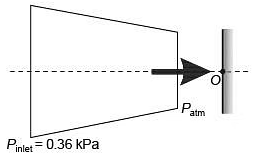
The inlet and outlet areas of the nozzle are 0.1 m2 and 0.02 m2, respectively. Take air density as constant and equal to 1.2 kg/m3. If the inlet gauge pressure of air is 0.36 kPa, the gauge pressure at point O on the plate (the point where the axis of nozzle touches the plate) is ________ kPa (round off to two decimal places).
Correct Answer :
Correct answer is : 0.375
Mass flow rate through nozzle remain constant
VO = 5 Vi
∴ V2 = 5 Vi
Bernoulli’s equation for nozzle
P2 = Patm = 0 (Gauge)
∴ V1 = 5 m/s V2 = 25 m/s
∵ P2 = PO = Patm = 0 (Gauge)
But at point O there will be a pressure due to motion of fluid which will exert a pressure on the plate.
Now,
Bernoulli’s equation between exit point & point O
∴ P3 = 0.375 kPa
Solution :
The correct answer is 0.375
1. Analysis of the Image and Given Data:
Based on the provided schematic diagram, air discharges steadily from a horizontal converging nozzle and impinges on a stationary vertical plate. The diagram highlights three critical parameters:
- The inlet gauge pressure is labeled as .
- The outlet discharges into the surrounding environment, which is at atmospheric pressure .
- The dashed horizontal centerline represents the nozzle axis, which terminates at point O on the vertical plate. Since the jet impinges normally on the plate, point O acts as a stagnation point where the air velocity is reduced to zero.
We are given the following values:
- Inlet area,
- Outlet area,
- Air density (constant),
- Inlet gauge pressure,
2. Applying the Continuity Equation:
Since the flow is steady and the density of air is constant, the mass flow rate through the nozzle remains constant. The volumetric flow rate is also conserved:
Substituting the given areas:
Simplifying this relation gives:
3. Applying Bernoulli's Equation to the Nozzle:
Applying Bernoulli's equation between the inlet (section 1) and the outlet (section 2) of the horizontal nozzle (neglecting potential energy differences since the nozzle is horizontal):
Since the nozzle discharges to the atmosphere, the gauge pressure at the outlet is:
Substituting the values of , , and the velocity relation into Bernoulli's equation:
Thus, the outlet velocity is:
4. Applying Bernoulli's Equation along the Free Jet Streamline:
Applying Bernoulli's equation along the central streamline from the nozzle exit (section 2) to the stagnation point O on the plate:
Since the flow stops completely at the stagnation point O, the velocity at point O is:
Thus, the gauge pressure is given by:
Substituting , , and :
Converting the pressure to kilopascals (kPa):
Therefore, the gauge pressure at point O on the plate is 0.375 kPa.
Access expert-curated educational resources and study materials—completely free.
Create, conduct, and manage professional online assessments with Mindyard. Perfect for teachers and institutes.
Copyright © 2026 Mindyard. All Rights Reserved.