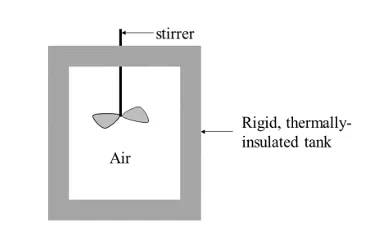
Air inside a rigid, thermally-insulated tank undergoes stirring as shown in the f igure below. Which one of the following options is correct?
Correct Answer :
Both the enthalpy and the entropy of the air increase
Solution :
The correct option is: Both the enthalpy and the entropy of the air increase.
Analysis of the Given Diagram:
Based on the provided illustration, we observe a closed system consisting of Air enclosed inside a Rigid, thermally-insulated tank. At the top of the tank, a stirrer is inserted, which performs mechanical work by stirring the air inside the chamber.
Let us break down the thermodynamics of this process step-by-step:
1. First Law of Thermodynamics & Enthalpy Change:
The first law of thermodynamics for a closed system is expressed as:
where:
• is the heat transfer across the system boundary.
• is the net work done by the system.
• is the change in the internal energy of the system.
Since the tank is specified as thermally-insulated (adiabatic), there is no heat exchange with the surroundings:
Since the boundary of the tank is rigid, the boundary work (expansion or compression work) is zero:
However, paddle-wheel work (stirring work, ) is done on the system. Therefore, the net work done by the system is negative:
Substituting these values into the first law equation:
This shows that the internal energy () of the air increases due to the mechanical energy input from stirring. For an ideal gas like air, internal energy is a function of temperature alone (), meaning the temperature () of the air increases.
Enthalpy () for an ideal gas is defined as:
Since both internal energy () and temperature () increase, the enthalpy of the air increases.
2. Second Law of Thermodynamics & Entropy Change:
The entropy change () of a closed system is given by the entropy balance equation:
where represents the entropy generated within the system boundaries.
Stirring is an inherently irreversible process because the mechanical energy of the rotating stirrer is dissipated into thermal energy via viscous friction within the air. This internal friction generates entropy, meaning:
Since the system is insulated, , simplifies the entropy change to:
Therefore, the entropy of the air increases.
Conclusion:
Since both thermodynamic properties experience a positive change, both the enthalpy and the entropy of the air increase during the stirring process.
Access expert-curated educational resources and study materials—completely free.
Create, conduct, and manage professional online assessments with Mindyard. Perfect for teachers and institutes.
Copyright © 2026 Mindyard. All Rights Reserved.