Air is contained in a frictionless piston-cylinder arrangement as shown in the figure.
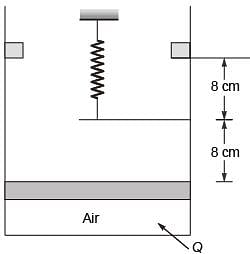
The atmospheric pressure is 100 kPa and the initial pressure of air in the cylinder is 105 kPa. The area of piston is 300 cm2. Heat is now added and the piston moves slowly from its initial position until it reaches the stops. The spring constant of the linear spring is 12.5 N/mm. Considering the air inside the cylinder as the system, the work interaction is ________ J. (round off to the nearest integer).
Correct Answer :
Correct answer is : 544
Given, initial pressure in the cylinder P = 105 kPa = 105 × 103 Pa and Area of the piston A = 300 cm2 = 300 × 10-4 m2 and dx = 16 cm
Work interaction = Work done by the piston at 105 kPa + Work done upon the spring
Work done by the piston = Pdv
dv = Area of the piston × displacement of the piston
∴ Work done by the piston= P × A × dx
Wpiston = 105 × 103 Pa × 300 × 10-4 m2 × 16 × 10-2 m = 504 J
Work done on spring = Strain energy absorbed by spring
∴ Work done on spring = 40 J
∴ Work interaction = 504 + 40 = 544 J
Solution :
The correct answer is 544.
Analysis of the Image & System Description:
By analyzing the provided schematic diagram, we can observe the following layout inside the piston-cylinder device:
1. The piston is initially at the bottom, containing the air system.
2. There is a clearance gap of 8 cm between the piston's initial position and the free end of the linear spring.
3. The distance from the free end of the spring to the upper stops is also 8 cm.
Thus, the expansion of the air system occurs in two distinct stages:
- Stage 1: The piston rises freely by 8 cm under a constant initial pressure before making contact with the spring.
- Stage 2: The piston continues to rise by another 8 cm against both the constant external force (atmospheric pressure and piston weight) and the linearly increasing resistance of the spring until it reaches the stops.
The total displacement of the piston is:
And the compression of the spring is:
Given Parameters:
- Initial pressure of air,
- Piston cross-sectional area,
- Spring constant of the linear spring,
Formulation of Work Interaction:
At any point during the quasi-equilibrium movement, the pressure force of the air is balanced by the atmospheric pressure, the weight of the piston, and the spring force:
Since the initial pressure of 105 kPa balances the atmospheric pressure and the piston weight before spring contact:
(where is the spring compression)
Therefore, the total work interaction done by the air is:
Evaluating this integral over the path gives:
This splits the work interaction into two parts:
1. Work done against the constant initial pressure force over the entire displacement ().
2. Work done to compress the spring ().
Step-by-Step Calculation:
1. Work Done by Piston against Constant Pressure:
Substituting the given values:
2. Work Done to Compress the Spring:
Substituting the given values:
3. Total Work Interaction:
Access expert-curated educational resources and study materials—completely free.
Create, conduct, and manage professional online assessments with Mindyard. Perfect for teachers and institutes.
Copyright © 2026 Mindyard. All Rights Reserved.