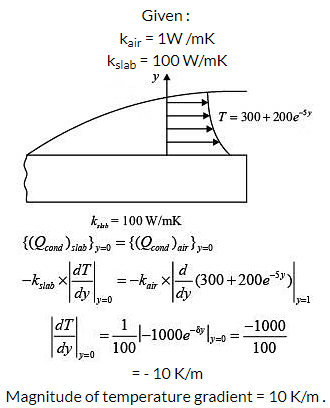
Ambient air flows over a heated slab having flat, top surface at 𝒚 = 𝟎. The local temperature (in Kelvin) profile within the thermal boundary layer is given by 𝑻(𝒚) = 𝟑𝟎𝟎 + 𝟐𝟎𝟎 𝐞𝐱𝐩 (−𝟓𝒚), where 𝒚 is the distance measured from the slab surface in meter. If the thermal conductivity of air is 1.0 W/m.K and that of the slab is 100 W/m.K, then the magnitude of temperature gradient |𝒅𝑻/𝒅𝒚| within the slab at 𝒚 = 𝟎 is _______________ K/m (round off to the nearest integer).
Correct Answer :
Correct answer is : 10
Solution :
The correct answer is 10.
Based on the provided schematic, we analyze the thermal boundary layer developing as ambient air flows over a heated slab with a flat top surface at y = 0. The image displays the given parameters:
- Thermal conductivity of air:
- Thermal conductivity of the slab:
- Local temperature profile in the air thermal boundary layer:
At the interface (), the heat flux leaving the slab by conduction must equal the heat flux entering the air boundary layer. Applying Fourier's Law of conduction at the interface yields:
First, we determine the temperature gradient in the air boundary layer by differentiating with respect to :
Evaluating this gradient at the interface surface ():
Next, we substitute the interface heat flux balance equation with the known values:
Taking the absolute value, the magnitude of the temperature gradient within the slab at is:
Access expert-curated educational resources and study materials—completely free.
Create, conduct, and manage professional online assessments with Mindyard. Perfect for teachers and institutes.
Copyright © 2026 Mindyard. All Rights Reserved.