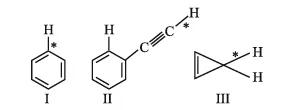
Among the given compounds I-III, the correct order of bond dissociation energy of C–H bond marked with * is:
Correct Answer :
II > I > III
Solution :
The correct option is II > I > III.
To determine the correct order of the bond dissociation energy (BDE) of the C–H bonds marked with an asterisk (*), we must analyze the hybridization of the carbon atom involved in each marked bond:
1. Compound I: The marked hydrogen is attached to a carbon atom in the benzene ring. This carbon atom is hybridized.
2. Compound II: The marked hydrogen is attached to the terminal carbon of the ethynyl (alkyne) group. This carbon atom is hybridized.
3. Compound III: The marked hydrogen is attached to the saturated methylene carbon of the cyclopropene ring. This carbon atom is hybridized.
The bond dissociation energy of a C–H bond is directly related to the s-character of the hybridized orbital of the carbon atom. A higher percentage of s-character means that the bonding electrons are held closer to the carbon nucleus, resulting in a shorter, stronger bond that requires more energy to cleave homolytically.
The s-character for different hybridization states is as follows:
Since the bond strength and dissociation energy increase with increasing s-character, the general order of bond dissociation energy for C–H bonds is:
By comparing the marked C–H bonds in the given compounds:
- Compound II involves a bond (highest s-character, strongest bond).
- Compound I involves a bond.
- Compound III involves a bond (lowest s-character, weakest bond).
Thus, the correct order of bond dissociation energy is II > I > III.
Access expert-curated educational resources and study materials—completely free.
Create, conduct, and manage professional online assessments with Mindyard. Perfect for teachers and institutes.
Copyright © 2026 Mindyard. All Rights Reserved.